
20 Creative Business Card Ideas Using Unique Materials and Shapes

Emma is our prepress and print production voice, built from the knowledge of our production team, with over 20 years in printing.
The materials that make a business card memorable are suede laminate, uncoated kraft board, 32pt ultra thick stock, real wood and plastic. The shapes are custom die cuts, circles, squares and slim formats. Every idea below names the stock or the cut that actually delivers it, what it starts at, and the limitation you will hit if you ignore it.
Materials and shapes at a glance
| Material or shape | Product at 4OVER4 | Starts at | Best for | The catch |
|---|---|---|---|---|
| Suede laminate | Suede business cards | $87.15 for 250 | Studios, salons, anyone who wants the card held longer | Fingerprints show on dark solids and pens will not write on it |
| 32pt ultra thick | Ultra thick business cards | $36.62 for 50 | Architects, tattoo artists, premium trades | A standard cardholder takes roughly half as many |
| Uncoated kraft board | Kraft business cards | $24.75 for 100 | Coffee, bakeries, makers, refill and repair brands | Pale colors go muddy on brown board |
| Real wood | Wood business cards | $470.11 for 250 | Joiners, guitar builders, gifts to key clients | Grain varies card to card and fine photo detail disappears |
| White, frosted or clear plastic | Plastic business cards | $180.02 for 250 | Membership, VIP access, anything that lives in a wallet for years | Nobody can write a note on the back |
| Preset die-cut shape | Die-cut business cards | $26.37 for 100 | Rounded corners, leaf, oval, half circle or circle | Seven preset shapes only |
| Custom outline | Die-cut any shape business cards | $95.56 for 50 | Any trade with a recognizable silhouette | A shape eats usable area, so the copy has to shrink |
| Raised foil on velvet laminate | Raised foil business cards | $86.78 for 100 | Law, property, jewelry, luxury service | Foil art has to arrive as a separate solid black vector layer |
| Spot UV on silk laminate | Spot UV business cards | $76.88 for 500 | Photography, design, agencies | The gloss picks up every fingerprint on a dark field |
Each price is the smallest run the configurator sells and rises with quantity, size and turnaround. Standard business cards at $17.57 for 100 are the control to compare against.
Why material and shape make a card memorable
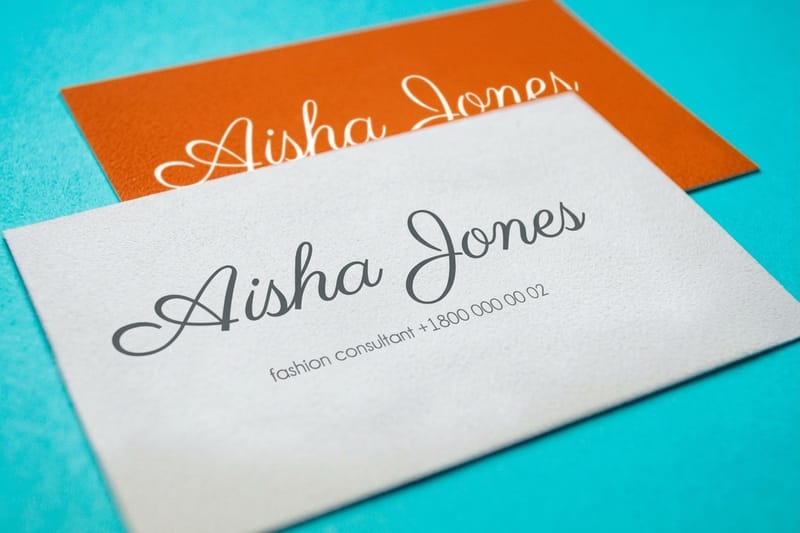
Nobody remembers a card by reading it. They remember it by the two seconds their fingers spent on it before it went in a pocket, which is why texture and thickness do more than a clever layout. A suede laminate, a 32pt edge, or a shape that is not a rectangle changes the physical event of handing the card over.
That is the whole mechanism, and it also explains where these ideas fail. A textured stock that nobody touches is wasted money, so it belongs in the hand at a meeting, not in a leaflet rack. A shape that costs a third of the printable area is worth it only if the shape itself says something about the trade.
The other thing texture buys you is silence. On a suede or an uncoated stock you can run one dark ink, a name and a number, and it still reads as expensive, which is a cheaper route to premium than piling on finishes. If minimal is the direction, our take on elegant minimalist business cards pairs well with everything below.
Texture, thickness and shape are three separate levers
Texture is the surface: suede, soft touch, uncoated kraft, linen. Thickness is the caliper of the board: a 16pt card and a 32pt card feel like different objects long before anyone measures either. Shape is the cut path, and it is the only lever visible across a room.
Pull one lever hard rather than all three gently. A 32pt uncoated card in a single ink is a stronger object than a 14pt gloss card carrying foil, spot UV and rounded corners at once. If you are still deciding on the base board, our stock guide and the 14pt versus 16pt comparison settle it in a couple of minutes.
Order samples before you order a run
Suede, soft touch and silk laminates photograph almost identically and feel nothing alike. The same is true of uncoated kraft against a matte coated brown. You cannot judge any of them on a screen, so hold them.
A sample pack costs almost nothing next to a run you regret, and it also tells you how a stock takes a pen. Our guide to using business card samples walks through what to check when the pack arrives.
The 20 ideas, and the stock behind each one
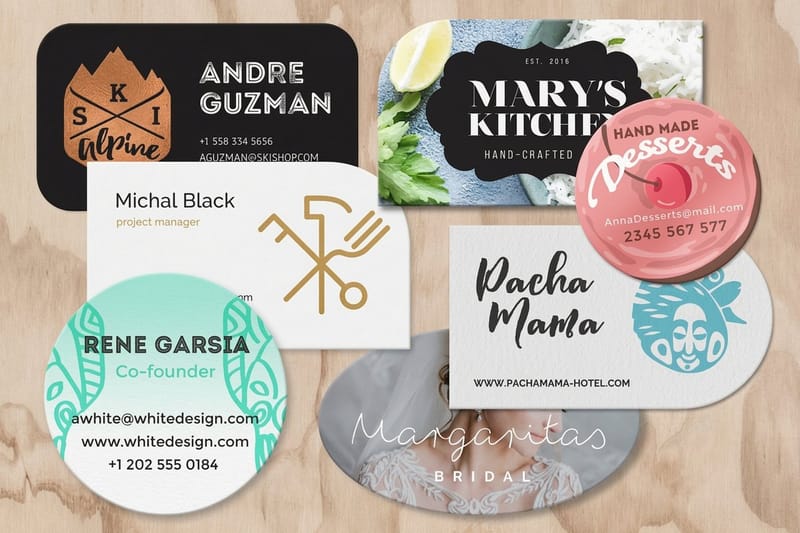
The ideas run roughly from the easiest to execute to the most involved, in four groups of five: stocks you can feel, shapes, finishes, and cards that do a second job.
Ideas 1 to 5: stocks you can feel
1. Suede laminate, one dark ink. Suede business cards start at $87.15 for 250 and carry a velvet surface you notice the moment you pick the card up. The catch: fingerprints show on large dark solids, and a ballpoint slides straight off, so skip suede for any card people write on.
2. A 32pt slab where the edge is the design. Ultra thick business cards start at $36.62 for 50 and read as an object rather than a piece of paper. The catch: a standard cardholder holds about half as many, so carry fewer and hand them out deliberately.
3. A painted edge stripe in your brand color. Edge painted business cards are 32pt UltraWhite uncoated board with the cut edge in one of 16 colors, a second brand surface that only shows when the card is held on its side. It only works if the edge color contrasts the face. Our walkthrough on how painted edge business cards are made covers what the process can and cannot hold.
4. Uncoated kraft board with a stamp aesthetic. Kraft business cards are 18pt board, $24.75 for 100, and take a pen beautifully, which suits a card with an appointment written on the back. The catch is real: kraft is brown, so pale CMYK colors sink into it and go muddy. Read how color prints on kraft paper before you commit artwork.
5. Real wood for your key clients. Wood business cards start at $470.11 for 250 because the card is beech or cherry wood, not a print of it. Grain varies card to card and fine photographic detail disappears into it, so treat these as a short run for the clients who matter, not as your everyday card.
Ideas 6 to 10: shapes cut out of the rectangle
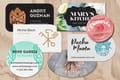
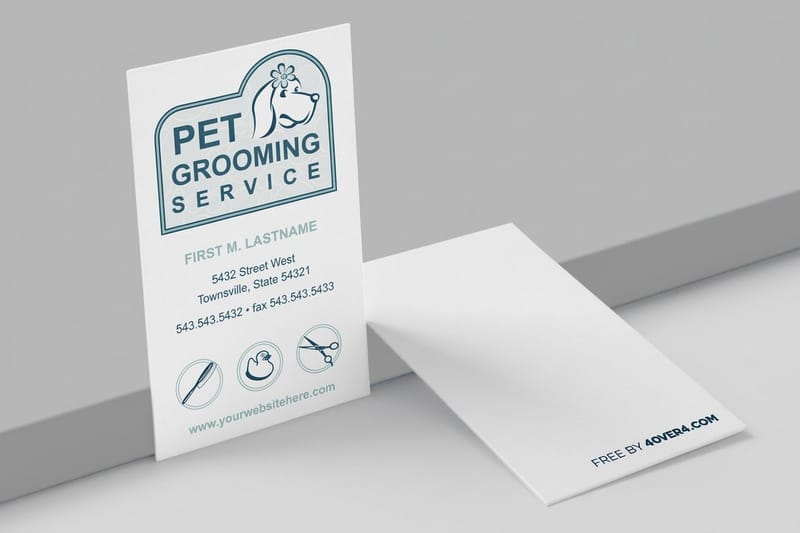
6. A silhouette of the thing you sell. A card cut to any shape, a house key, a wrench, a cupcake or a paw, makes you the only non-rectangle in the stack. It is cut inside a 2 x 3.5 inch footprint with a Basic or Complex shape die, from $95.56 for 50.
7. A circle instead of a rectangle. A 2.5 inch circle has about a third less printable area than a 3.5 by 2 inch card. Plan for a name, a trade and one contact route. Our round die-cut card guide gives the working sizes.
8. A shape borrowed from the trade. A leaf for a landscaper, a molar for a dentist, a key for a locksmith. It reads instantly and stops the card looking like a novelty, because the shape is doing a job. The leaf is one of the seven preset shapes on die-cut business cards; a molar or a key needs a custom die. See leaf shaped business cards for how far to push the outline before it becomes hard to cut.
9. A slim card at 3.5 by 1.5 inches. Half the height, all of the width, and it still fits a wallet. It forces a brutal edit down to one line and one contact route, which is usually an improvement. Sizes are in our square, folded, slim and mini card guide.
10. A square card. Square business cards come in 2, 2.5 and 3 inch squares. Square reads as design-led and photographs well for social. The catch is that it does not sit flat in a standard wallet slot, so it suits people who file cards rather than pocket them. We weighed it up in are square business cards a good idea.
Ideas 11 to 15: finishes that do the talking
11. Raised foil on a soft velvet field. Raised foil business cards start at $86.78 for 100, in gold, silver or holographic foil on 16pt velvet laminated cover. The contrast between the soft ground and the sculpted metal is what reads as expensive, not the quantity of foil, and the raised foil setup guide shows how much to use.
12. Spot UV pattern on silk laminate. Spot UV business cards start at $76.88 for 500 and include a 16pt silk laminated stock, where a gloss pattern on a matte ground is felt before it is seen. Suede cards take spot UV as an option too. The catch is fingerprints on a dark matte field, so keep the gloss shapes generous and the dark areas smaller.
13. Blind deboss with no ink at all. Pressing the mark into the board and printing nothing over it is the quietest premium finish there is. Debossed business cards come on 32pt or 48pt silk or velvet laminate, thick enough to hold the impression. The mechanics are in embossed business cards explained.
14. A duplex sandwich with a colored core. Two boards bonded around a third color leaves a stripe visible only on the edge, which is the same trick as a painted edge with a cleaner line. Layer cake business cards are the catalog version: a center seam in one of 5 colors inside 32pt to 60pt board. Start with duplex business cards and what a sandwich business card is.
15. A lenticular card that changes as it tilts. Two artworks interlaced under a lens, so the card animates in the hand. It will not hold small type or fine serif detail, so use it for one image and keep the contact block on the flat reverse. See how 3D lenticular business cards work.
Ideas 16 to 20: cards that do a second job
16. A frosted or solid plastic card. Plastic business cards start at $180.02 for 250 on white, frosted or clear 20 point plastic, and survive a wallet for years, which makes them right for membership, access and VIP tiers. The catch is that nobody can write on the back, so skip them for any card that needs a handwritten note.
17. A bookmark card. A tall narrow card stays in a book instead of a bin, and it suits editors, tutors, therapists and anyone whose client reads. The layout rules are in bookmark business cards.
18. A punch card on the reverse. Ten small circles and a rubber stamp turns the card into a reason to keep it. Our loyalty card guide covers the redemption maths before you print thousands.
19. A two-part card that only completes when both halves meet. A die-cut window on one card that frames an image on the second, or a card that slots into another. It works for partnerships and for referral schemes, and it doubles your artwork, so budget for two designs rather than one.
20. The eco card, said honestly. We do not print seed paper, so a plantable card is not something to order here. What we do stock is 18pt kraft board made from 100% post-consumer waste, the closest genuine option. For the wider material question, read bamboo and eco-friendly card options and green business card design ideas.
Premium stocks and finishes that make the ideas real
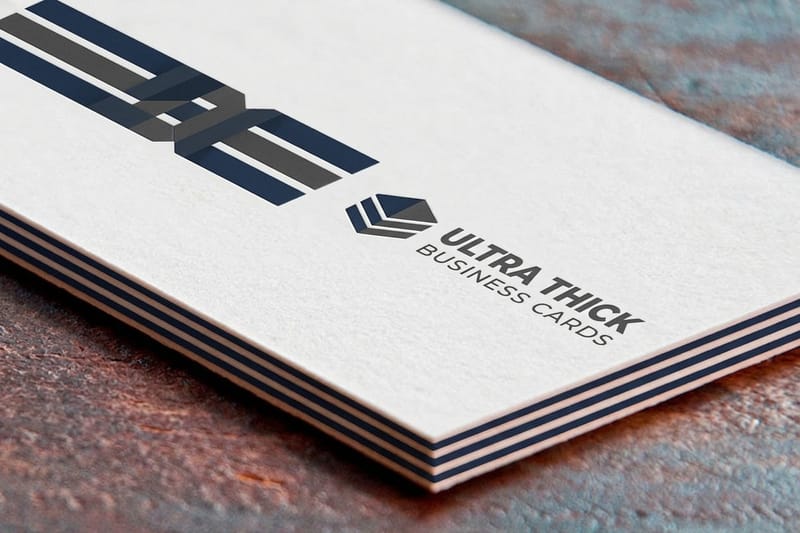
Three decisions set the price of every idea above: the board, the finish on top of it, and whether the card is cut to a shape. Artwork changes nothing about cost.
The board is where the feel comes from. A 16pt coated stock is the everyday baseline; 32pt ultra thick is the jump that gets noticed; kraft and other uncoated boards trade color range for texture. Wood and plastic are separate materials rather than paper, and their prices reflect that.
Finish is applied after printing and it is where a modest board turns into a card people keep. Suede and soft touch change the surface across the whole card. Raised foil, spot UV and deboss act on selected areas of the card.
Business card pricing and specs at 4OVER4.COM
The table below shows the preset die-cut card: seven shapes, from a 2 x 3.5 inch card with rounded corners to a 2.5 inch circle, on 14pt or 16pt gloss, 14pt uncoated, linen, synthetic plastic or magnet stock.
Quantity and price
Die-cut business card pricing and specs
Real configurator numbers for the seven preset shapes, where a larger run drops the per card cost.
| Quantity | Price Per Unit | Total |
|---|---|---|
| 100 | 26.4¢ | $26.37 |
| 200 | 15.9¢ | $31.86 |
| 300 | 12.8¢ | $38.45 |
| 400 | 10.2¢ | $40.64 |
| 500 | 9.45¢ | $47.24 |
| 600 | 8.97¢ | $53.83 |
How to set up files for die-cut and specialty cards
A shaped or specialty card fails in the file, not on the press. The cut path has to be one closed vector on its own named layer, drawn with a solid spot stroke and no fill, with no live text, no open paths and no clipping masks inside it. Convert every letterform to outlines first, as covered in converting text to outlines.
Print it
Cards cut to your own outline
A Basic or Complex shape die inside a 2 x 3.5 inch footprint, on 27 stocks.
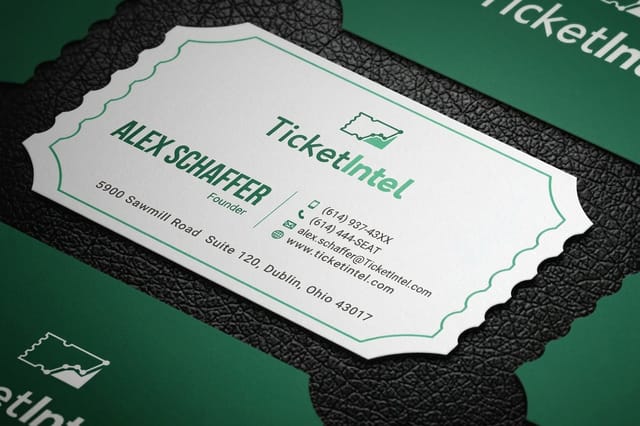
Bleed and safety are the other half. Run background artwork 0.125 inches past the cut path so no white sliver appears after cutting, and inset all type 0.125 inches inside it. On a shaped card that safe zone is an offset copy of the outline rather than a rectangle. The mechanics are in full bleed printing explained, and the base layout rules sit in our business card outline and file setup guide.
Finishes need their own layers too. Raised foil and spot UV both arrive as a separate 100% black vector layer above the artwork, marking exactly where the effect lands. A raster mask or a gray tint will be rejected, because the press needs a hard edge to make the plate from. For the broader process, see die cutting explained.
Matching the concept to your industry
The right idea is the one that says something true about the trade. Here is where each direction lands.
- Trades and construction. A die-cut wrench or house outline on kraft board, one dark ink, and a back surface that takes a pen for a quoted price. Cheap enough to reprint when the number changes.
- Salons, spas and studios. Suede or soft touch, minimal type, no gloss. The card is a sample of how the space feels, which is the entire pitch.
- Property and law. Raised foil on 16pt velvet laminate. Conservative shape, restrained color, and the finish carrying all of the signal.
- Design, photography and agencies. A slim or square suede card with spot UV, so the card is both an object and a portfolio piece.
- Makers, cafes and refill brands. Uncoated kraft with a stamp-style mark, and a punch card printed on the reverse so it stays in the wallet.
Blanks for die-cut and specialty stock
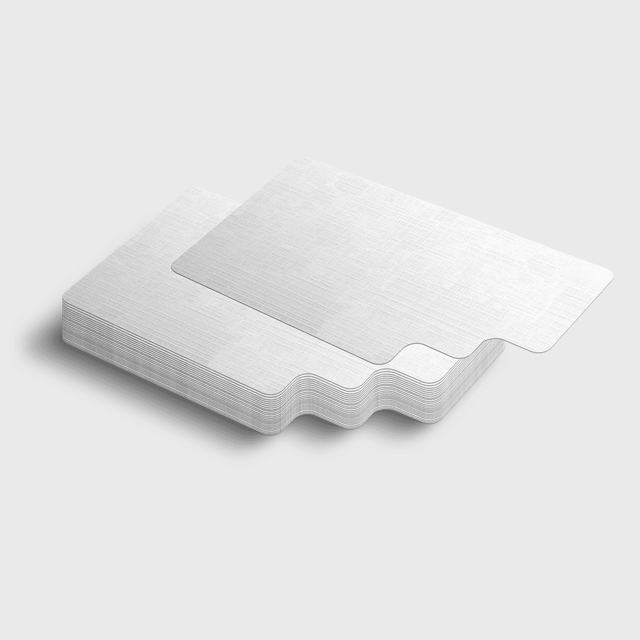
The blank press files below come from the business card range, die-cut and lenticular cards among them. Grab the one for your card from the blank template library, drop your design in, and keep the type clear of the cut.
Start fast
Blanks for die-cut and specialty stock
Design templates and blank press files from the business card range.
Wally picks the material before the layout
Texture, thickness and shape are three separate levers
Pull one lever hard rather than all three gently. Kraft at $24.75 and die-cut at $26.37 sit near the price of a normal premium card, suede at $87.15 buys a surface people hold, and wood at $470.11 is a short run for the clients who matter. Whatever you pick, hold type 0.125 inches inside the cut path and give foil or spot UV its own solid black vector layer.
Order die-cut business cards →What the material decides before the layout does
Explore more
More ways to print a card people keep
Products and guides for a card built on material and shape.
Product Die-Cut Business Cards Seven preset shapes, from rounded corners to a 2.5 inch circle. Product Suede Business Cards A 16 point suede laminate with a velvet feel. Product Ultra Thick Business Cards 32pt board where the edge is part of the design. 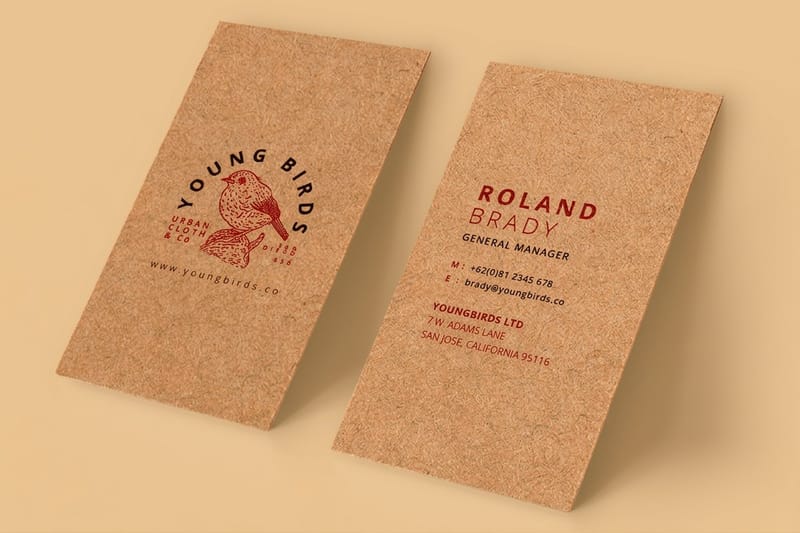 Product Kraft Business Cards Uncoated brown board that still takes a pen.
 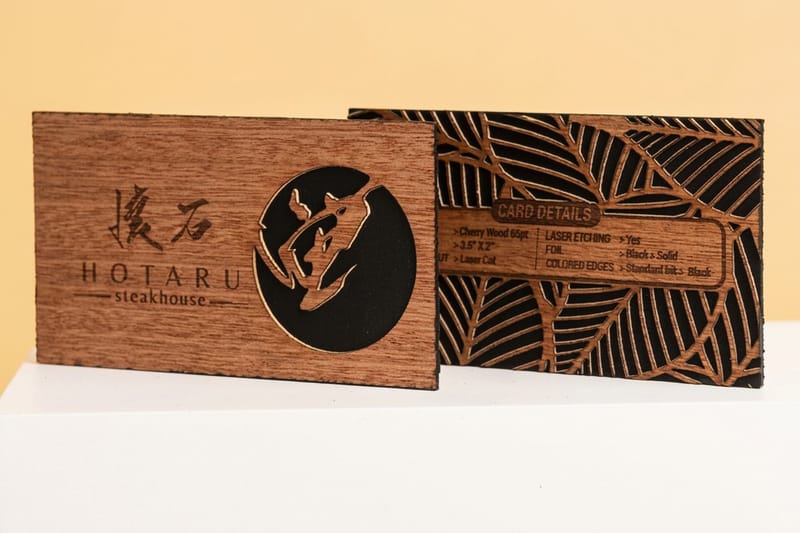 Product Wood Business Cards Beech or cherry wood for a short run that gets kept.
 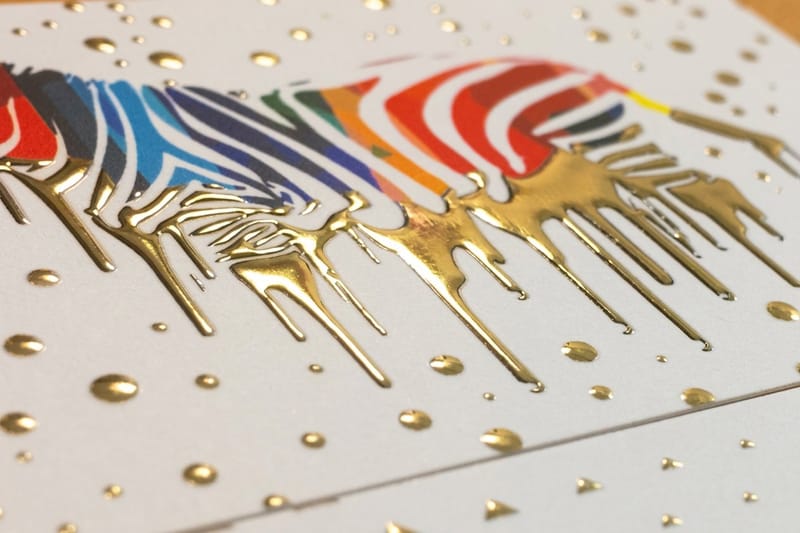 Product Raised Foil Business Cards Sculpted metal on a soft velvet ground.
  Category Business Card Printing Every stock, finish and shape in one place.
  Guide Business Card Shapes Guide Which outlines cut cleanly and which fight the die.
 Ready to print the idea?
Pick a preset shape or send your own outline, choose the board, and check the proof before 4OVER4.COM cuts the run.
Common questions about unique business card materials
What is the cheapest way to make a business card look unusual?
Change the shape or the board rather than the finish. A preset die-cut shape and kraft board both start at 100 cards for under $30, while suede, plastic, debossed and wood cards start at 250 cards and cost $87 or more. Order the shape first and add a finish on the reprint once the design is settled.
Can you print white ink on kraft business cards?
Yes. Kraft business cards offer CMYK + White on the front only or on both sides, so white type and light tones print on the brown board. Without the white ink, white areas are simply the board showing through.
Which file do I send for a die-cut business card?
For one of the seven preset shapes, place your art on the blank for that shape. For your own outline, order Die-Cut Any Shape business cards, choose a Basic or Complex shape die in the configurator, and send the cut path on its own layer with the artwork.
Are wood business cards worth the price?
For a short run to the clients who matter, often yes. The card is 65 point beech or cherry, the surface is laser engraved, laser etched or foil stamped, and edge painting or edge gilding can be added. Allow 15 business days and keep the design to a bold mark and a few lines of type.
Can I add foil or spot UV to a die-cut card?
Not on the die-cut products: both the preset and the any shape die-cut cards offer a standard finish or high gloss UV coating only. For a finish plus a softer outline, spot UV and suede cards take rounded corners at a 1/8 or 1/4 inch radius.
