
Canvas Prints Online That Turn Business Printing Into Art


Before you order a canvas print online, check two things: your file width in pixels divided by the inches you want across, and the wrap style, because the frame takes roughly an inch and a half of image from every edge. Above 150 pixels per inch at final size is safe at room distance, and 4OVER4.COM prints premium canvas from $59 and square canvas from $59, stretched on a wooden frame and ready to hang the day it arrives.
Canvas sizes, viewing distance and the file you need
| Where it hangs | Common size | Viewing distance | Minimum file | Wrap that suits it |
|---|---|---|---|---|
| Desk ledge or shelf | 11 x 14 in | Under 3 ft | 2200 x 2800 at 200 PPI | Mirror wrap |
| Office wall behind a desk | 16 x 20 in | 4 to 6 ft | 2400 x 3000 at 150 PPI | Gallery wrap |
| Reception or waiting area | 24 x 36 in | 8 ft or more | 3600 x 5400 at 150 PPI | Gallery wrap |
| Square grid of three | 20 x 20 in each | 6 to 8 ft | 3000 x 3000 at 150 PPI | Gallery wrap |
| Corridor or storefront statement | 30 x 40 in | 10 ft or more | 3000 x 4000 at 100 PPI | Solid colour edge |
The pixel figures are the arithmetic, not a rule: 150 PPI across a 24 by 36 face is 3600 by 5400 pixels. Further back you can drop to 100 and nobody standing in the room will see the difference. You can order premium canvas prints in these sizes straight from the configurator.
What to check before you upload a file

The number that decides whether your canvas looks good is pixels at final size, not megapixels. A standard phone photo at 4032 by 3024 pixels prints clean at 20 by 15 inches, because that works out to 201 pixels per inch across the finished face, and the canvas weave cannot resolve much beyond that anyway.
This is where canvas quietly beats a photographic gloss print. The texture scatters light in every direction, so grain, a little focus softness and the noise a phone adds in a dim room all sink into the weave instead of sitting on top of it. The same file that looks mushy at 20 inches wide on gloss can look deliberate on canvas.
Colour behaves differently, and it is worth knowing before you are disappointed. Matte canvas has a narrower gamut than a glossy photo stock, so the deepest blacks land closer to a very dark grey and the most saturated reds and blues pull back a step. Push contrast up slightly before you upload. In exchange you get the one wall product that does not bounce a ceiling spotlight straight back at whoever is looking at it, which is the whole argument in our acrylic prints vs canvas prints guide.
Work out your maximum size with one division
Take the pixel width of your file and divide it by the width in inches you want on the wall. Above 150 you are safe at normal room distance. Between 100 and 150 is fine for anything hung above eye level or viewed from more than eight feet, which covers most reception walls. Below 100 the weave starts carrying the image and the edges of hard shapes go soft.
Resampling a small file upward in Photoshop does not add detail, it only adds pixels, and on canvas it usually adds a faint plastic smoothness as well. If the file is genuinely small, print it small or print it square. A crisp 20 by 20 square canvas reads as a considered choice; a stretched 40 inch version of the same file reads as a mistake.
What canvas will not print well
Hairline rules, 6pt legal type and logos with fine reverse-out detail all lose definition on a woven surface. If your piece depends on small type staying readable, that piece does not belong on canvas. Print the type on something smooth and let the canvas carry the image.
Flat fields of a single light colour are the other weak spot. A large area of pale grey or cream shows the weave more than a busy photograph does, and any banding in a gradient becomes easier to spot. Break the field with texture, or accept it and pick a smaller size.
Wrap styles, and what each one costs you
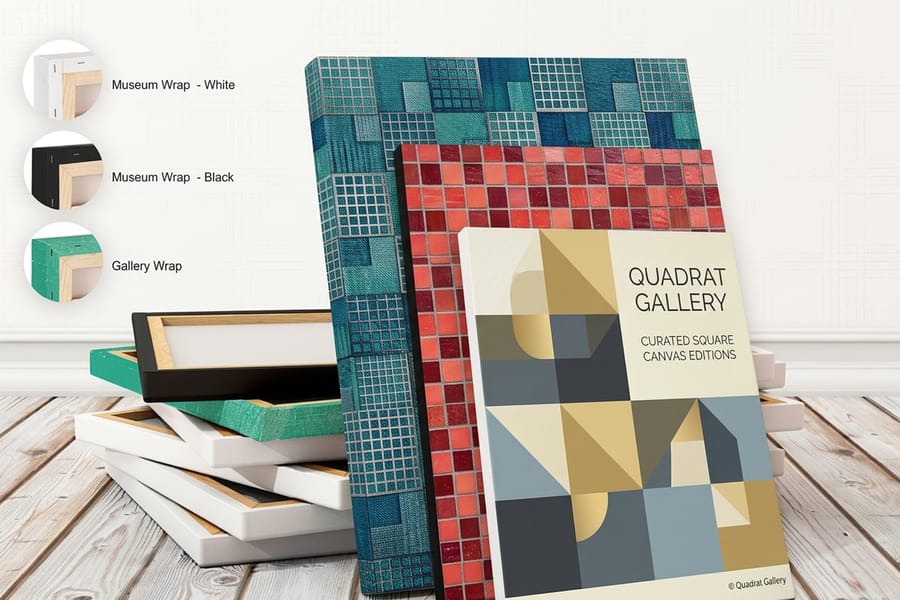
Every stretched canvas hides part of your image around the sides of the frame. On a common gallery bar that is roughly an inch and a half per edge, so a 24 by 36 piece gives up about three inches of width and three of height before anyone on the wall side sees it. Check the depth listed on the product page, then crop for it.
There are three ways to handle that edge. A gallery wrap continues the photograph around the sides, which looks best and costs you the most image. A mirror wrap flips a strip of the border outward so the sides are a reflection, and nothing from the face is lost. A solid colour edge fills the sides with black, white or a brand colour, which suits graphics and logos better than photographs.
Pick the wrap before you crop rather than after. Almost every canvas that comes back looking wrong was cropped as a flat rectangle and then wrapped, and the frame ate whatever was near the edge.
Which wrap suits which image
Landscapes, textures and anything with generous empty margin take a gallery wrap well, because the part that bends onto the frame is sky, floor or blur. Group photographs and product shots usually want a mirror wrap, since a shoulder or a bottle cap disappearing around a corner is the sort of detail people notice immediately and never stop noticing.
Brand graphics, typographic pieces and single-colour logos belong on a solid edge. The frame then reads as a border rather than a continuation, and your logo stays whole on the face where you put it.
The crop mistake that shows up on the wall
Watch the horizon and any strong straight line near an edge. A horizon that sits an inch from the bottom of your crop bends onto the frame and the piece looks tilted from across the room even when it hangs perfectly level. Move the line further in, or move it out to the edge deliberately.
The safe habit is simple. Add the wrap depth to every side of your intended crop, keep every face, logo and hard line inside the original rectangle, and treat the extra band as material the frame will take.
Canvas, acrylic or framed paper for a business wall
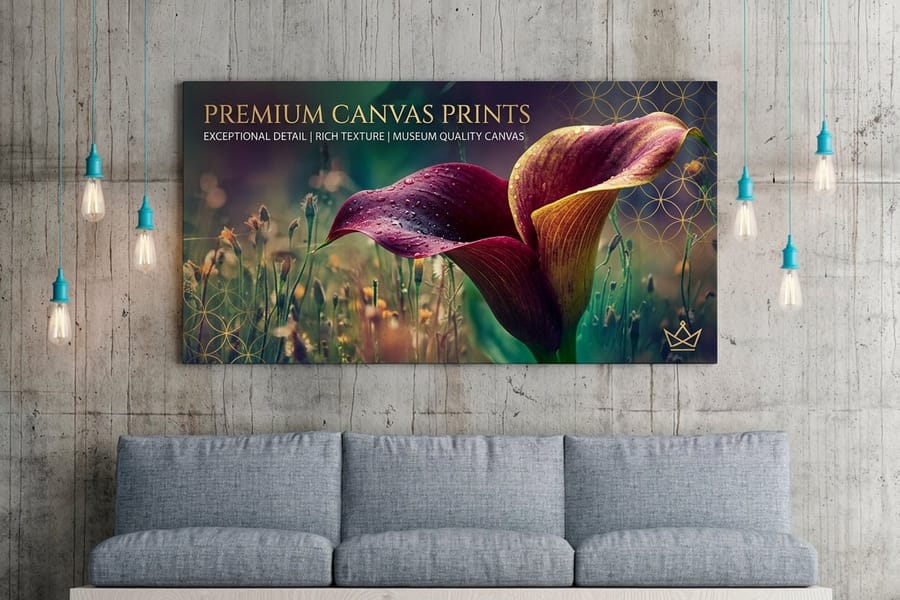
Glare usually decides this, not taste. Offices and lobbies are lit from the ceiling, and a glossy acrylic panel or a framed print behind glass will show you the light fittings from half the positions in the room. Matte canvas does not, which is why it keeps winning in reception areas that were specified with acrylic on the drawing.
Weight decides the rest. A stretched canvas is fabric over a light wooden frame and normally hangs from a single anchor, so it goes up in a rented office without a conversation about the walls. An acrylic panel of the same face size is heavier and wants proper fixings, and it earns that trouble when the image has fine detail and deep colour worth showing off. Our acrylic vs canvas vs framed canvas comparison takes it apart side by side, and the whole acrylic print range sits next door if gloss is what the image needs.
The honest limit: do not hang canvas, or anything else printed, in a west-facing window and expect the colour to hold for years. Direct sun fades every ink there is. Put the canvas on the wall opposite the window instead, where the light is doing the good half of its job.
What each one is genuinely best at
Canvas is best for photography, artwork and anything atmospheric at a decent size, in a room with overhead light. Acrylic is best for high-detail images, product photography and deep saturated colour where you can control the lighting. Framed paper behind glass is best when the piece is small, precise and typographic, and when you want it to read as a document rather than as art.
For a multi-panel effect across a wide wall, split one image over several stretched pieces rather than buying one very large canvas. The split canvas layouts article covers nine arrangements that work, and a set of squares is the easiest of them to hang straight.
Small canvas that sits on furniture
Not every canvas goes on a wall. Desk-sized and easel-backed pieces work on a reception counter, a shelf behind a till or a trade show table, and they move with you rather than needing a fixing. The easel back and desk canvas article covers the sizes that stand up without tipping.
At that size go back to the pixel maths and be generous, because people pick these up. Aim for 200 pixels per inch or better on anything that will be handled or read from arm’s length.
Canvas pricing and specs at 4OVER4.COM
Canvas pricing moves with the face size and the quantity, and the per piece cost drops as the run grows. The numbers below come from the live configurator, so you can size a whole wall before you commit to one panel.
Quantity and price
Canvas print pricing and specs
Real configurator numbers on premium stretched canvas, including the sizes and the frame details.
| Quantity | Price Per Unit | Total |
|---|---|---|
| 1 | $59.00 | $59.00 |

Ordering online instead of walking a file into a local shop is what makes a set of five affordable in the first place, and the trade-off is that you check the file yourself rather than over a counter. Our take on that swap sits in the outsourced printing guide. You can also earn coins on every order and put them against the next wall.
The canvas texture, in the hand
The same weave that makes a wall piece look like art makes a business card feel unlike every other card in the stack. Canvas business cards start at $17.57 and carry a fabric-textured face, which is worth doing when the brand on the wall and the brand in the pocket should feel like the same thing. The same limit applies as on the wall: fine reverse-out type and hairline rules soften on a textured face, so set the type a size up and keep the logo simple.
Print it
Premium canvas, ready to hang
Stretched on a wooden frame, matte face, hung from a single anchor.
If you want to see how your artwork reads at card size before paying for a textured stock, run it on free business cards first and hold the result at arm’s length. It is a smooth stock rather than canvas, so it will not tell you how the texture feels, but it will tell you whether the type survives the size. The full range sits under business card printing, and the case for ordering online rather than locally is laid out in our business card printer vs online printing guide.
Choosing canvas by business type
Different rooms have different problems, so here is the breakdown by business type.
- Professional offices. One large canvas behind reception, plus a set of squares along the corridor. Matte kills the downlight reflection that makes framed prints unreadable in a lit lobby.
- Restaurants and cafes. Food photography prints forgivingly on canvas because the weave hides the noise a low-light kitchen shot picks up. Keep it off the wall nearest the fryer.
- Salons and studios. Portfolio work at 16 by 20, changed as the work changes. Cheap enough to rotate seasonally rather than hang once and forget.
- Retail and storefronts. Big statement pieces in the 30 by 40 range on the wall facing the door, not in the window where direct sun will fade them.
- Trade show and events. Light frames travel well and hang from a single hook on a booth wall. Pair them with print collateral so the stand reads as one brand, which is the point our design marketing guide keeps returning to.
None of this is a wall decoration exercise. A lobby that looks like the brand does the same job as the mailer and the ad campaign in our be everywhere article, and if you are still naming the thing, the art and craft business name ideas list is a reasonable place to start. Everything a new business prints in its first year is collected in the business basics collection.
Templates and print-ready blanks
If you are not starting from a photograph, templates save an afternoon. 4OVER4.COM sizes its blanks to the exact product specs, so your artwork lands inside the cut line with the wrap allowance already marked. Grab a print-ready blank from the blank template library before you start laying out.
Start fast
Templates and print-ready blanks
Design templates and exact-size blanks so your image lands where the frame expects it.
Wally sizes a canvas before he crops it
Do the division first, then crop for the wrap
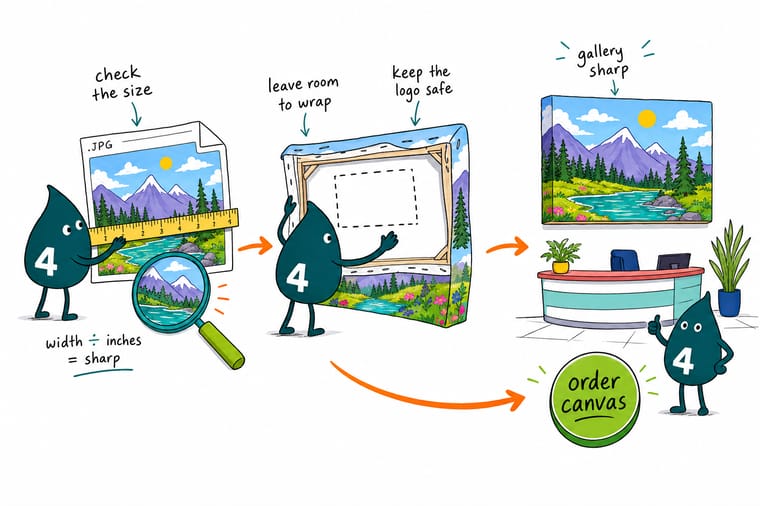
Divide your file width in pixels by the inches you want across: above 150 PPI is safe at room distance, and 100 is fine above eye level. Then add the frame depth to every side of your crop, because a gallery wrap bends roughly an inch and a half of image onto each edge. Lift contrast slightly for matte canvas, keep faces and logos inside the original rectangle, and 4OVER4.COM stretches it on a wooden frame ready to hang.
Order canvas prints →What to remember about canvas prints
Design tips that hold at every size
- Divide before you decide. Pixel width divided by inches across. Do it before you fall in love with a size, not after you have hung the wrong one.
- Crop for the wrap. Add the frame depth to every side and keep faces, logos and hard lines inside the original rectangle.
- Lift contrast a little. Matte canvas mutes the extremes. A small contrast and saturation bump before upload lands closer to what is on your screen.
- Print one, then commit. Hang a single piece in the actual light for a week before ordering the set. Rooms lie about colour more than monitors do.
- Match the frame depth across a set. A grid of canvases with mixed depths reads as an accident from the doorway. Order the group together.
Explore more
More ways to print for the wall
Related products, categories and reading on 4OVER4.COM, one card each.
 Product Premium Canvas Prints Stretched canvas for offices, lobbies and storefronts, from $59.
  Product Square Canvas Prints Squares hang straight and grid cleanly across a wide wall.
 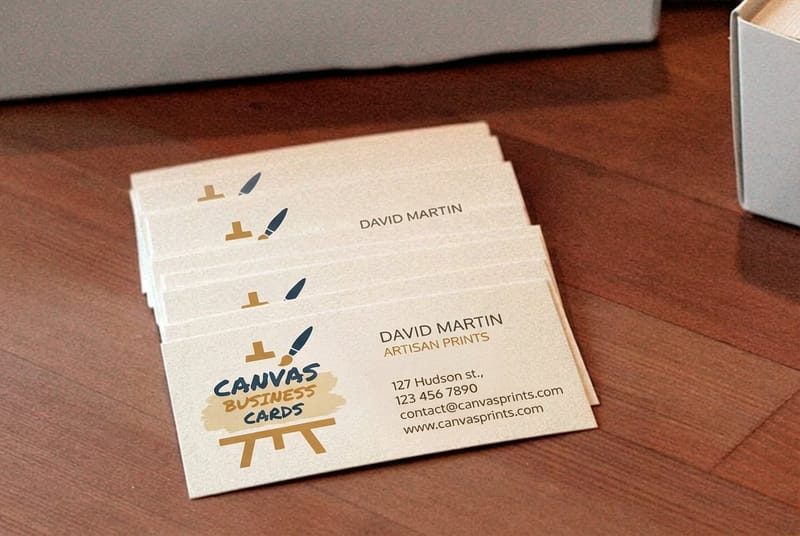 Product Canvas Business Cards The same woven texture, in the hand, from $17.57.
 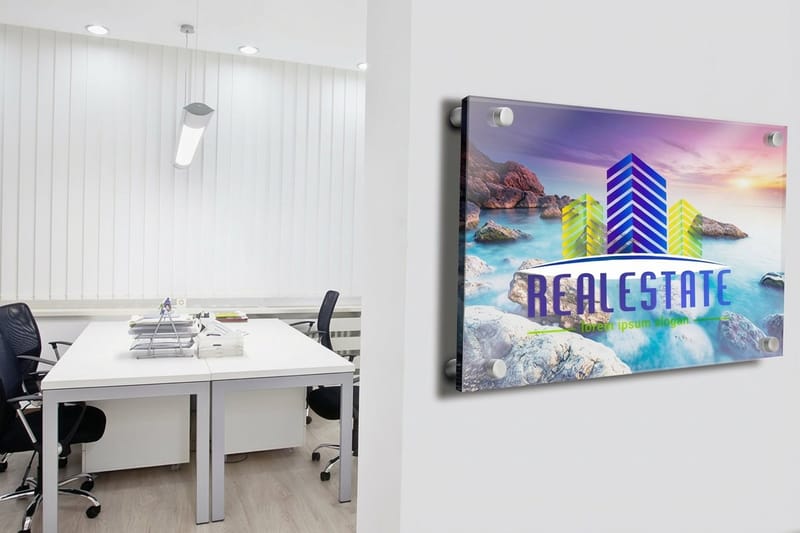 Category Acrylic Print Printing Gloss, depth and fine detail when the room lighting allows it.
 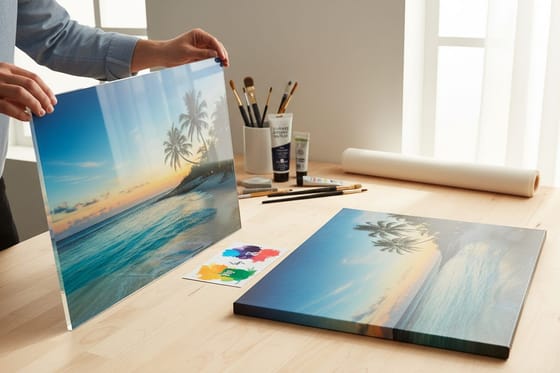 Guide Acrylic Prints vs Canvas Prints Which surface suits which image, and which room.
  Article Split Canvas Layouts Nine multi-piece arrangements that work on a real wall.
 Ready to hang something?
Pick your size, upload the file, choose the wrap, and 4OVER4.COM stretches it on a wooden frame and ships it ready to hang.
Common questions about canvas prints
How large can I print a phone photo on canvas?
Take the pixel width of the file and divide by the inches you want across. A 4032 by 3024 pixel photo gives you 201 pixels per inch at 20 inches wide, 134 at 30 inches and 101 at 40 inches. All three are printable on canvas, because the weave scatters light and hides the detail loss that would be obvious on a gloss photo stock. The practical ceiling is where the image is viewed from: at 30 by 40 inches on a corridor wall people stand back, and at 100 pixels per inch nobody sees the difference. On a desk at arm’s length, aim for 200 or better.
What is the difference between a gallery wrap and a mirror wrap?
A gallery wrap continues your actual photograph around the sides of the frame, so the piece has no visible border from any angle and roughly an inch and a half of image per edge is no longer on the face. A mirror wrap flips a strip of the border outward, so the sides are a reflection of the edge of the image and nothing from the face is lost. Use a gallery wrap when the edges of the shot are sky, blur or floor. Use a mirror wrap for group photos, product shots and any image where something important sits close to the edge.
Will the canvas match what I see on my screen?
Close, but not exactly, and the difference is predictable rather than random. A monitor emits light and a matte canvas reflects it, so the deepest blacks print as a very dark grey and the most saturated reds and blues come back a step. The fix is a small contrast and saturation lift before you upload, not a big one. If colour accuracy matters for a brand piece, order one small canvas first and look at it under the lights it will actually hang in, because room lighting shifts perceived colour more than the printer does.
Can I hang a canvas print in a kitchen or a bathroom?
You can, with two cautions. Stretched canvas is fabric under tension, and it tightens and slackens slightly as humidity swings, so a room that goes from steam to dry twice a day will make the surface move more than a lounge wall will. Keep it off an exterior wall that gets cold and damp, and off the wall directly behind a hob or a shower. In a commercial kitchen or a busy cafe, put the canvas in the dining area and use an acrylic or a laminated print anywhere it will be wiped down.
Do canvas prints need a frame?
No. A stretched canvas arrives on its own wooden frame, wraps around the edges and hangs as it is, which is the reason it is the quickest wall piece to put up in a rented office. A floater frame is an optional extra look that leaves a small gap between the canvas and the surround, and it suits fine art more than it suits business photography. If you want a piece to read as a formal document rather than as art, that is the point at which framed paper behind glass makes more sense than canvas at all.
