
Hang Tag Sizes for Apparel, Retail, and Gift Products


There is no one hang tag size. The right dimensions follow the product, from a 2 x 3.5 in apparel tag to a slim jewelry strip to a bottle-neck tag. Here is the full sizing guide, with string-hole and bleed rules that make any tag print clean.
Hang tag size follows the product it hangs from. Apparel tags run about 2 x 3.5 in, accessories and bags sit near 1.5 x 3 in, jewelry uses a slim 0.75 x 2.5 in strip, and food or gift tags use a 2.5 in square. Set a 3 to 5 mm string hole about 6 mm from the top, keep it clear of your text, and add 0.125 in of bleed plus a safe margin so nothing gets cut or drilled off.
Start here
Hang tag sizing in one paragraph
Size the tag to the product first. Apparel tags run near 2 x 3.5 in, accessories near 1.5 x 3 in, jewelry uses a slim strip, and gifts use a 2.5 in square. Plan a 3 to 5 mm string hole clear of your copy, add 0.125 in of bleed and a safe margin, and pick a stock that fits the brand. The chart below shows each size by product type.
Why hang tag size is the first decision, not the last
A hang tag looks like a small detail, but its size shapes how a product feels on the shelf and in the hand. Too big and it overwhelms a delicate item or gets in the way. Too small and there is no room for the logo, price, and care details a buyer expects. Getting the dimensions right is the difference between a tag that finishes a product and one that fights it.
The important thing to understand up front is that there is no universal hang tag size. The right dimensions follow the product: a jacket, a candle, a necklace, and a wine bottle each want a different size and often a different shape. This guide gives you the proven ranges for every common category, plus the string-hole and bleed rules that make any tag print cleanly.
Whatever you are tagging, you can print it to the exact size here. Our custom hang tags come in any dimension, stock, and finish, and the full custom printing collection covers the specialty shapes and materials brands reach for.
What is a hang tag, and the standard size ranges
A hang tag is a small printed card attached to a product by string, ribbon, or a plastic fastener, usually through a punched hole near the top. Unlike a sewn-in label, it hangs free, which is why it is prime real estate for branding, pricing, and the details a shopper checks before buying. If you want the deeper background, our guide on what hang tags are covers the history and uses.
Because tags serve so many products, sizes fall into ranges rather than one number. Apparel tags cluster around 2 x 3.5 in. Accessories and jewelry go smaller, near 1.5 x 3 in or a slim strip. Food, candle, and gift tags often use a 2.5 in square, and bottles use a rounded neck tag with a die-cut opening. The table further down lists each one.
Two things stay constant across every size: the string hole and the print margins. Plan a 3 to 5 mm hole about 6 mm from the top, keep it clear of your copy, and treat bleed and safe margins exactly as you would for a retail hang tag or any other printed piece.
Apparel and clothing hang tag sizes
Clothing is where hang tags do their heaviest branding, so apparel tags need enough room to work. The classic garment tag runs about 2 x 3.5 in, which comfortably fits a logo and brand name on the front and size, price, and care details on the back. It is large enough to be seen and small enough to hang neatly from a collar, sleeve, or waistband.
Minimalist and lightweight brands sometimes prefer a trimmer 1.75 x 3 in tag for a cleaner look, while premium labels may size up for presence. The material choice matters as much as the dimensions here: order hang tags for clothing on a thick coated card for a polished retail feel, or on kraft stock for an earthy, sustainable brand story.
Whatever size you land on, keep the layout breathable. A logo and price on the front, supporting details on the back, and plenty of margin around the string hole read far better than a crowded tag trying to say everything at once.
Accessory, jewelry, and retail tag sizes
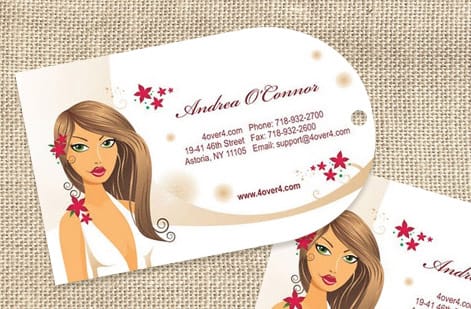
Smaller products call for smaller tags so the tag complements the item rather than swallowing it. Bags, shoes, belts, and general accessories look clean with a compact tag near 1.5 x 3 in, which still holds a logo, price, and a short line of copy. For jewelry, go slimmer still: a 0.75 x 2.5 in strip loops neatly through earrings, necklaces, and small pieces without adding bulk.
Retail environments reward tags that scan and price quickly, so leave room for a barcode or SKU on the back and keep the front focused on brand and price. A retail hang tag on a sturdy stock survives repeated handling on a busy sales floor, and a die-cut shape can set your brand apart from the standard rectangle.
The rule of thumb: the more delicate or premium the item, the more restraint the tag should show. A small, well-finished tag signals quality far better than a large one crammed with text.
Food, bottle, and gift tag sizes
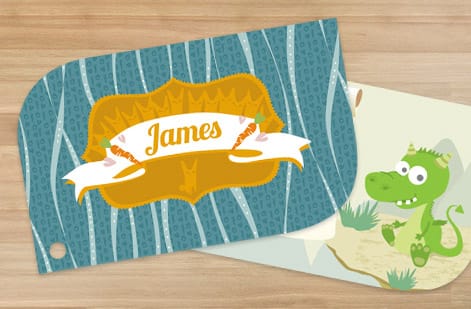
Food, candle, and gift products lean toward square and rounded tags that feel warm rather than commercial. A 2.5 x 2.5 in square is a versatile default for baked goods, candles, soaps, and gift packaging, giving space for a brand mark, a short story, and any ingredient or allergen note the product needs.
Bottles are their own case. A neck tag around 3.5 x 4 in with a die-cut circular opening slips over the neck of a wine, oil, sauce, or beverage bottle and hangs at the shoulder, a prime spot for branding and a special-occasion message. Because these tags often carry a premium product, a durable plastic tag or a foil-finished card elevates the presentation.
For handmade and natural goods, kraft hang tags reinforce an authentic, small-batch feel. Match the shape and material to the product's personality, and the tag becomes part of the gift, not just a price marker.
Shapes, materials, and the all-important string hole
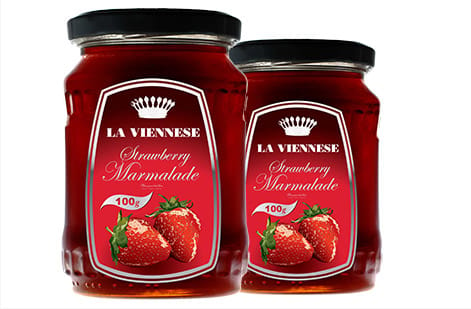
Size is only half the spec. The shape, material, and hole placement finish the job. Rectangles are the workhorse, but a rounded corner softens the look, and a full die-cut shape like a scallop, tag point, or custom silhouette makes a brand memorable. Just remember that a more complex shape needs a little more margin around the edges.
Materials shape the feel. A thick coated card looks crisp and retail-ready, kraft reads natural and sustainable, and plastic or a laminated card stands up to weather and heavy handling. For durability guidance across substrates, our guide on choosing paper stocks and materials is a useful reference.
The string hole ties it all together. Set a 3 to 5 mm hole about 6 mm from the top edge, and keep it clear of your logo and text so nothing gets punched through. A hole placed thoughtfully lets the tag hang straight and square, which is what makes a shelf of products look sharp.
How to design the tag and what to put on it

A great hang tag says just enough. Lead with the brand: put your logo and, where relevant, the price on the front so the tag works as a shelf-level ad. Reserve the back for the practical details, size, materials, care instructions, a barcode, and increasingly a QR code that links to a product page, sizing chart, or styling content.
Keep the layout breathable and let the string hole sit in clear space. Use a type size that stays legible at the tag's small scale, and keep small text a true single black rather than a four-color mix so fine letters print crisp. For the fundamentals of a mark that reproduces well at tag size, pair this with our logo design best practices.
Above all, resist the urge to fill every inch. The most effective tags carry two or three key details and let the product and the brand do the rest. A clean tag reads instantly, and that split-second impression is exactly what a hang tag exists to make.
What custom hang tags cost to print
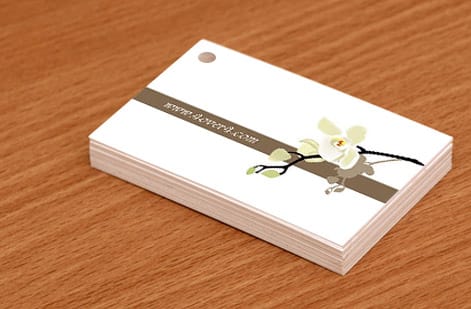
Because they are small, hang tags are among the most affordable custom pieces to print, and the price is easy to reason about. It scales with quantity, size, stock, finish, and any special cutting such as a die-cut shape or a bottle-neck opening. Larger runs lower the per-unit price quickly, so ordering for a full season or product line is usually the most economical move.
Premium touches like foil, spot UV, soft-touch coating, or a rounded die-cut add to the cost but can dramatically lift a tag's perceived value, which matters for gifts and premium goods. In the 4OVER4.COM configurator every option updates the price live, so you can weigh a heavier stock or a special finish against your budget before you commit.
Use the live specs and pricing panel below to build your custom hang tags, or order free samples first to feel a couple of stocks and sizes against your actual product. The full custom printing collection has the specialty options when a standard tag is not enough.
Wally sizes a tag to its product
The right dimensions follow the item, not a default
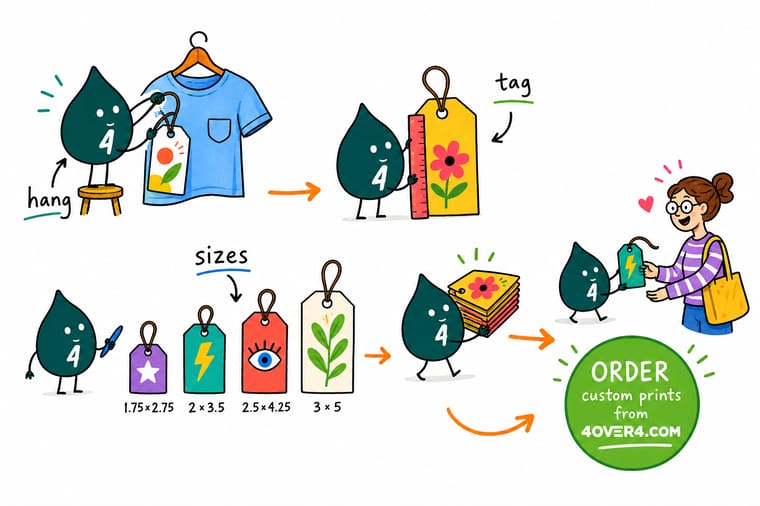
Wally never starts a hang tag from a template. He starts from the product: a garment gets a 2 x 3.5 in tag, a bag gets a compact one, a bottle gets a die-cut neck tag. Then he sets the string hole clear of the text, adds bleed and a safe margin, and picks a stock that fits the brand. Size it to the product and every tag hangs straight and reads clean.
Order your custom hang tags →Quick reference
Hang tag size chart by product type
Start from the product, then pick a size in its proven range. Here are the standard dimensions and the best use for each hang tag type.
| Tag type | Standard size | Best for |
|---|---|---|
| Apparel tag | 2 x 3.5 in | Fits a logo, size, price, and care note for shirts, jackets, and general clothing. |
| Small apparel tag | 1.75 x 3 in | A trimmer garment tag for lightweight or minimalist clothing brands. |
| Accessory tag | 1.5 x 3 in | Right scale for bags, shoes, and belts where a large tag would look bulky. |
| Jewelry tag | 0.75 x 2.5 in | A slim strip that loops through earrings, necklaces, and small pieces. |
| Food or gift tag | 2.5 x 2.5 in | A square that suits bottles, candles, baked goods, and gift packaging. |
| Bottle neck tag | 3.5 x 4 in with cutout | A rounded tag with a die-cut neck opening for wine, oil, and sauce bottles. |
| String hole | 3 to 5 mm, 6 mm from top | Keeps the tag hanging straight and clear of the printed copy. |
Step by step
Size and order a hang tag in 7 steps
- Start from the product, not a template Decide what the tag hangs on first. A jacket, a candle, and a necklace each call for a different size and shape, so let the item set the dimensions.
- Pick a standard size in its range Choose a proven size for that category, such as 2 x 3.5 in for apparel or a 2.5 in square for gifts, so the tag feels right in hand and on shelf.
- Plan the string hole placement Mark a 3 to 5 mm hole about 6 mm from the top edge, positioned clear of your logo and text so nothing gets punched through.
- Set bleed, trim, and safe margin Add 0.125 in of bleed on every side and keep all copy 0.125 in inside the trim so cutting and drilling never clip your design.
- Choose a stock and finish Match the material to the brand: kraft for natural goods, thick coated card for retail, or durable plastic for tags that take handling.
- Add only the information the tag needs Front for logo and price, back for size, care, materials, or a QR code. Keep it uncluttered so the tag reads at a glance.
- Proof at 100 percent and order View the tag at actual size, confirm the hole sits clear of text, then set quantity and finish in the configurator and place the order.
Specs and pricing
Custom hang tag specs and live pricing
Once your size is set, the print choices come down to stock, finish, and shape. Here are the live specs and price-per-unit for custom hang tags at 4OVER4.COM, straight from the configurator.
| Quantity | Price Per Unit | Total |
|---|---|---|
| 50 | 50.5¢ | $25.27 |
| 100 | 28.6¢ | $28.56 |
| 200 | 15.9¢ | $31.86 |
| 300 | 12.4¢ | $37.35 |
| 400 | 10.2¢ | $40.64 |
| 500 | 8.79¢ | $43.94 |
| 600 | 8.24¢ | $49.43 |
| 700 | 7.53¢ | $52.73 |
Print it
Order hang tags in any size at 4OVER4
See it in use
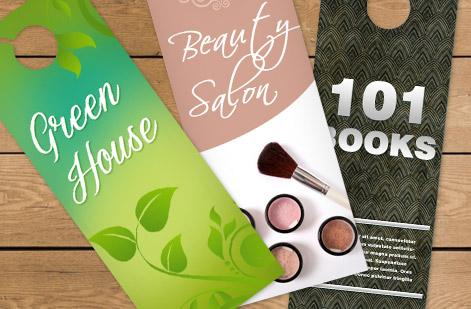
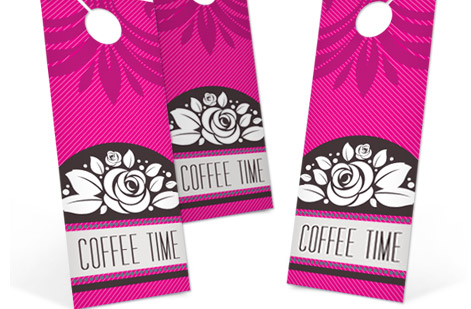
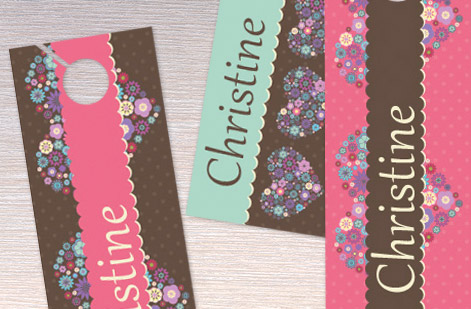
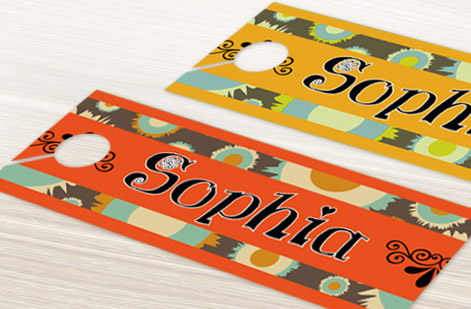
Real hang tags, printed in-house


Explore more
Where to go next


By the numbers
Custom tags you can count on at 4OVER4
Common Questions
Common questions about hang tag sizes
How to design hang tags that print cleanly?
Design a hang tag like any small print piece, with three rules layered on top. First, size it to the product: about 2 x 3.5 in for apparel, 1.5 x 3 in for accessories, and a 2.5 in square for gifts. Second, plan the string hole as part of the layout, a 3 to 5 mm circle set roughly 6 mm from the top and kept clear of your logo and text. Third, add 0.125 in of bleed past the trim and keep all copy 0.125 in inside the safe margin so nothing is lost when the tag is cut and drilled. Put your logo and price on the front, save details like size and care for the back, and proof the design at 100 percent zoom before ordering custom hang tags.
What information should you add on hang tags?
Only what the buyer needs at the point of sale, kept uncluttered so the tag reads at a glance. The front usually carries the brand logo, the product name, and the price. The back is the place for supporting details: garment size, fabric or material, care instructions, a barcode or SKU, country of origin, and increasingly a QR code that links to a product page or styling video. For food and gift tags, an ingredient or allergen line and a short brand story work well. The goal is a tag that informs without overwhelming, so choose the two or three details that matter most for your product and let the rest live online.
What is a standard hang tag size?
There is no single standard, because the ideal size follows the product the tag hangs from. That said, a few sizes act as reliable defaults. Apparel tags cluster around 2 x 3.5 in, which gives room for a logo, size, price, and care note. Smaller accessory and jewelry items look best with a compact tag near 1.5 x 3 in or a slim 0.75 x 2.5 in strip. Food, candle, and gift tags often use a 2.5 x 2.5 in square, while bottles use a rounded neck tag around 3.5 x 4 in with a die-cut opening. Pick the size in the range that suits your item and your printed content.
How do I choose the right hang tag size for my product?
Match the tag to three things: the size of the product, the amount of information you need to show, and the shelf presence you want. A large garment can carry a 2 x 3.5 in tag comfortably, while a delicate piece of jewelry needs a slim strip so the tag does not dominate the item. If you must list size, care, and a barcode, lean toward the larger end of the range or use both sides of the tag. Finally, consider the display: a boutique may want a premium, generous tag, while a high-volume retailer may prefer a compact one. Order free samples in a couple of sizes and hold them against the actual product before committing to a full run.
What does hang tag printing cost and how are prices set?
Hang tag price scales with the same levers as any print job: quantity, size, paper stock, finish, and any special cutting like a die-cut shape or a bottle-neck opening. Larger runs drop the per-unit price sharply, a heavier or specialty stock adds a little, and premium finishes such as foil, spot UV, or soft touch cost more than a standard coating. At 4OVER4.COM you set each option in the configurator and the price updates live as you adjust it, so you can see exactly how size and finish change the number before you order. Because tags are small, they are one of the more affordable custom pieces to print in volume.
Do hang tags need bleed and a safe margin?
Yes. A hang tag is cut from a larger sheet and then drilled for the string, so both the cut and the hole can shift by a hair. Add 0.125 in of bleed on every side so any background color or image runs past the trim with no white slivers, and keep all text and logos 0.125 in inside the trim so nothing important lands near the blade. Just as important, position the string hole clear of your copy, since a hole punched through a letter or logo ruins an otherwise clean tag. Follow those rules and every tag in the run comes out consistent.
Get Started
Ready to print hang tags sized right for your product?
Order custom hang tags at 4OVER4.COM in any size, shape, stock, and finish. Adjust every option and watch your price update live.
Legal Disclaimer
Gold Standard guarantees apply to all standard orders placed through 4over4.com. Price match requires verifiable proof of a competitor's published price for an equivalent product with matching specifications and turnaround time. Satisfaction guarantee covers manufacturing defects and print quality issues. Contact support with order number and documentation. On-time delivery rate based on tracked orders 1999 to 2026. Individual results may vary based on shipping carrier performance.
