
Best Canvas Prints for Museum Worthy Wall Art at Home


A canvas print looks museum worthy when four things line up: a heavy poly cotton weave stretched tight over deep bars, pigment ink under a protective coat, a file that holds 150 PPI at the finished size, and a crop that leaves room for the wrap. Miss any one of them and the piece reads as a poster with texture, no matter how good the photograph was.
Wall art formats compared
| Format | Surface | Fine detail | Glare | Best for | At 4OVER4 |
|---|---|---|---|---|---|
| Gallery wrapped canvas | Woven poly cotton, matte | Softens fine detail | None, matte and unglazed | Painterly art, landscapes, portraits at scale | Premium canvas prints, from $59 |
| Square canvas | Same weave, 1:1 crop | Softens fine detail | None | Grid walls, social photos, symmetrical rooms | Square canvas prints, from $59 |
| Framed print | Smooth paper behind a moulding | Holds fine detail | Depends on the glazing | Documents, type, black and white photography | Framed prints printing |
| Acrylic print | High gloss acrylic face | Highest detail and depth | Reflective, needs controlled light | Saturated color, night shots, modern interiors | Acrylic prints printing |
| Ready made print | Preset sizes, stock ready | Format dependent | Format dependent | Filling a wall on a budget or testing a layout | Ready made prints, from $15.00 |
Pick the format from the room before you pick it from the price. A wall facing a window rules out gloss, and a piece hung within arm's reach rules out a low resolution enlargement. You can browse the full canvas range or start with premium canvas prints from $59.
What separates a museum grade canvas from a cheap one

Four things decide it: the weight of the canvas, the ink, the protective coat, and how tightly the piece is stretched over its bars. Artwork quality matters, but a beautiful file printed on limp canvas with dye ink will still look like a poster with texture on it.
Start with the substrate. Canvas made for printing is a poly cotton weave with a receptive coating on the face, and the heavier weaves hold tension better once they are stretched. A light canvas relaxes, and a relaxed canvas shows a shallow ripple across the middle when light rakes across it from a window. You notice it from the side of the room long before you notice anything about the image.
Ink is the longevity decision. Pigment ink puts solid particles on the surface and keeps its color for years under normal room light. Dye ink soaks in, looks gorgeous on day one, and shifts first in the reds and yellows. Then there is the coat on top: a protective layer takes the scuffing and the household dust instead of the ink, which is the only reason you can wipe a canvas at all. Our explainer on what canvas prints are walks through how the layers stack up.
Why the weave changes what you should print on it
Canvas has a physical texture, and that texture sits between the viewer and every fine edge in your file. It flatters brushwork, skin, foliage, weather and grain. It fights hairline type, engineering drawings, and the delicate mid tone steps in a black and white photograph, where the weave breaks the gradation into small facets.
That is the honest limit. If your piece lives or dies on razor detail, print it on smooth paper and frame it, or go to acrylic. Our acrylic versus canvas comparison lines the two up on detail, glare and cost, and the three way version with framed canvas adds the option most people forget exists.
The tension test you can do in a shop
Press a fingertip into the middle of a stretched canvas. It should give a little and spring straight back with no lasting dent and no audible slack. Then look along the surface from the side with a light behind you. A well stretched piece reads as one flat plane, and the corners fold cleanly instead of bunching into a lump under the frame.
Humidity moves canvas. A piece hung in a bathroom or a kitchen that steams will loosen and tighten with the seasons, and that cycling is what eventually leaves a permanent wave. Hang those rooms with framed prints instead and keep canvas for living rooms, bedrooms and offices.
The resolution your photo actually needs
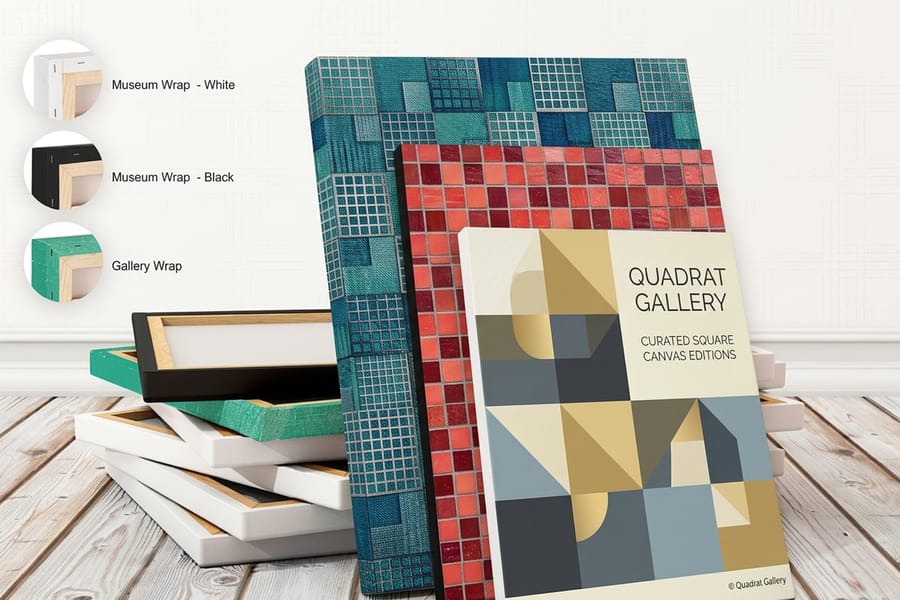
Aim for 150 PPI at the finished size, and treat 100 PPI as the floor for anything large enough that people stand back to look at it. Canvas is more forgiving than paper for exactly the reason above: the weave is already breaking up the surface, so it hides the softness that would be obvious on a smooth sheet.
The arithmetic is simple. Divide each pixel dimension by the PPI you want and you get inches. A 4000 by 3000 pixel photo at 150 PPI gives you 26.7 by 20 inches. The same file at 100 PPI stretches to 40 by 30 inches, which is fine above a sofa and too soft above a desk where someone sits two feet away. Viewing distance is half the specification, and almost nobody writes it down.
One thing people get wrong in the other direction: uploading a file at 300 PPI does not make a canvas sharper than 150 PPI. The ink cannot resolve detail finer than the weave. It just gives you a much larger upload for no visible gain. If you are starting from phone photos, our walkthrough on turning photos into wall art covers the whole path from camera roll to print file.
When to upscale, when to crop, when to change the plan
Modern upscaling handles a two times enlargement on a clean, well exposed photo without anyone noticing on canvas. It cannot invent detail that was never captured, so a dark, noisy phone shot at night gets worse when you enlarge it, not better. Noise enlarges beautifully and detail does not.
If the file will not stretch to the size you want, crop tighter and print smaller rather than blowing it up, or split it. A multi piece split canvas covers more wall from the same pixels because each panel only carries part of the image, and a panoramic crop does the same thing horizontally.
Why the print looks darker than your screen
Your monitor emits light and a canvas reflects it, so shadows that separate clearly on a bright screen collapse into one dark mass on the wall. Matte canvas has the shortest tonal range of the wall art formats, which is the price of having no glare at all.
The practical fix is to open the shadows and lift overall brightness slightly before you send the file, then judge the result in the room where it will hang rather than at the desk. Order one small piece first. At $59 a premium canvas is a cheap rehearsal for a large one, and ready made prints from $15.00 are cheaper still if you only want to check a crop.
Depth, wrap and how the piece hangs
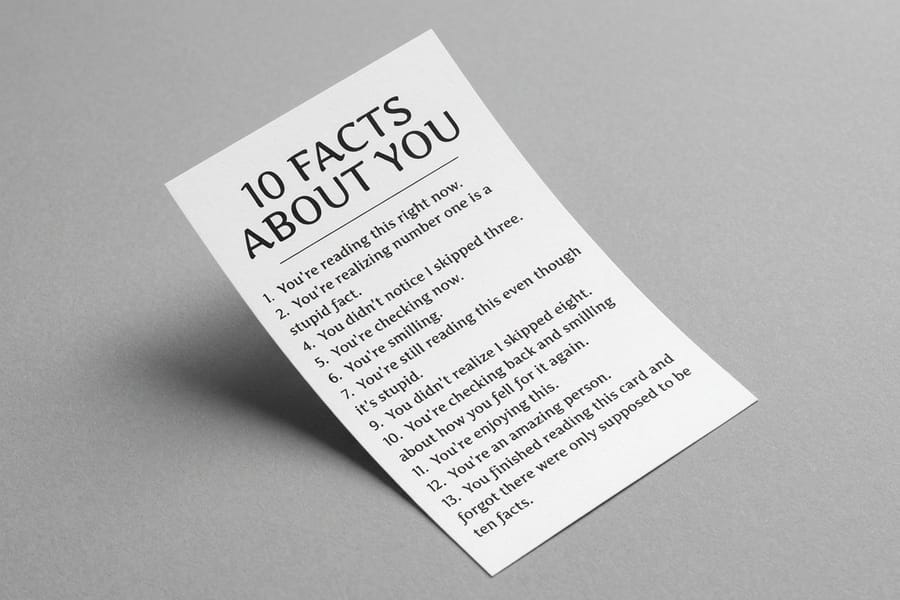
Bar depth is the choice that makes a canvas read as an object rather than a picture. A shallow bar sits close to the wall and looks like a print. A deeper bar throws a shadow line under the bottom edge and reads as a piece of art from across the room, which is most of what people mean when they say museum worthy.
Depth costs you image, though. Whatever wraps around the sides is not visible from the front, so plan for it: keep faces, horizons and any text at least an inch and a half inside the edge, and leave enough background around the subject that the fold has something to eat. This is the single most common reason a canvas comes back disappointing, and it is a layout decision, not a printing one.
You have three ways to treat the sides. Wrap the image itself, which suits landscapes and abstracts with room to spare. Mirror the edge, which reflects the outer strip so nothing real is lost, and is the safe pick for tight crops. Or run a solid color edge, usually black or white, which frames the image cleanly and never fights it. When in doubt, mirror.
Hanging it so it looks intentional
Center the piece so its middle sits at roughly eye level, around 57 to 60 inches from the floor, and drop that in a dining room where everyone is seated. Above furniture, leave six to eight inches of wall between the sofa back and the bottom of the canvas so the two read as one arrangement rather than two objects that happened to collide.
Canvas is light for its size, so the fixing is rarely the problem. Two hooks spaced apart beat one in the middle because the piece cannot pivot out of level every time someone shuts a door. If you would rather add a moulding around the canvas for a heavier gallery look, framing a canvas print covers floater frames and the depths that fit.
Light is what actually ages the print
No print survives direct sunlight. Pigment ink and a protective coat buy you years of normal room light, and a few hours a day of sun through an unshaded south window will still shift the piece long before the canvas or the frame gives up. Move it off that wall, or accept it as consumable and reprint.
Halogen and other hot spotlights bake a surface if they sit close. LED washes are cooler and kinder. Dust with a dry microfiber cloth, never a wet one, and never a cleaning spray. The coat is protecting the ink, and solvent takes the coat off first.
Canvas specs and wrap options at 4OVER4.COM
Premium canvas prints start at $59 and the price moves with the finished size and the quantity. The choice that shapes the piece, though, is the wrap. Our canvas is stretched on 1.5 inch bars, and you decide whether the image itself folds around them or the sides run a solid edge.
Wrap and finish
Canvas print specs and wrap options
Straight from the live configurator: gallery wrap folds the image around the bars, museum wrap gives you a clean white or black edge instead.

Gallery wrap is the right call when the image has spare background at the edges. Museum wrap with a white edge keeps the piece feeling light and gallery like, and the black edge version reads heavier and works better against a pale wall. Take a free online proof before production either way, because the proof is where you catch a horizon or a face sitting too close to the fold.
You can also earn coins on every order and redeem them against future printing, which helps when a single wall turns into a set of five.
Square canvas, grids and multi piece walls
One large canvas is the simplest way to make a wall look finished, but it is not always the right answer. A grid of squares suits a room with a wide, low wall, and it is far easier to hang level than a single oversized piece. It also lets you spread the cost over several orders instead of one, and swap a single panel later without redoing the arrangement.
Print it
Square canvas, ready to hang
One to one crops in matching sizes, the fastest way to build a grid wall that lines up.
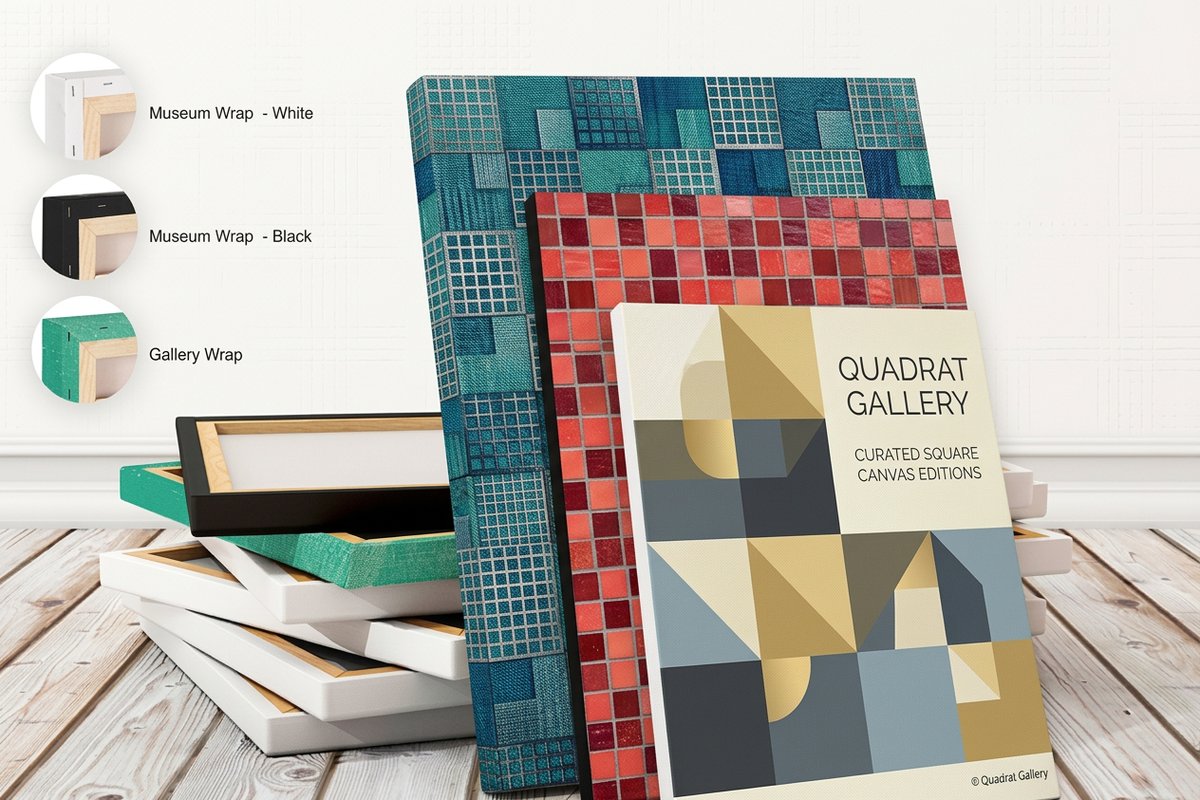
Keep the spacing between panels tight and identical, usually two to three inches, so the group reads as one work rather than several. Mixing orientations in the same grid almost never works; mixing sizes only works when there is a clear dominant piece and the rest are obviously secondary. For splitting a single image across panels, nine ways to use split canvas art covers the layouts that hold together, and easel back and desk canvas is the small format version for shelves and studios.
Choosing the format for the room
The room decides more than the artwork does. Here is where each format earns its place.
- Living rooms and bedrooms. Stable temperature, indirect light and a viewing distance of eight feet or more. Canvas is the format these rooms were made for, and larger works better than a cluster of small pieces.
- Home offices and studios. Anything hung two or three feet from a desk needs 150 PPI or better, because the viewer is close enough to read the weave. Keep detailed work smaller here.
- Kitchens and bathrooms. Steam and humidity cycle the canvas, so use framed prints in these rooms and keep canvas dry.
- Rental walls and short stays. Ready made prints from $15.00 let you fill a wall without committing money to something you cannot take with you.
- Galleries, cafes and pop ups. Square canvas prints in a repeating grid make a hanging look curated, and a matching set is faster to install and rehang than mixed sizes.
Cheap ways to test a wall first
Before committing to a large canvas, print the layout small. Ready made prints from $15.00 let you hang the actual crop at a reduced size and live with it for a week, which catches the two mistakes that matter: the piece is smaller than the wall needs, and the color reads differently under the room's own light. If you want a no cost version of the same test, foam board art projects shows how to mock up a wall with cheap board first.
Wally checks the four things that make a canvas look museum worthy
Weave, ink, resolution and the wrap allowance
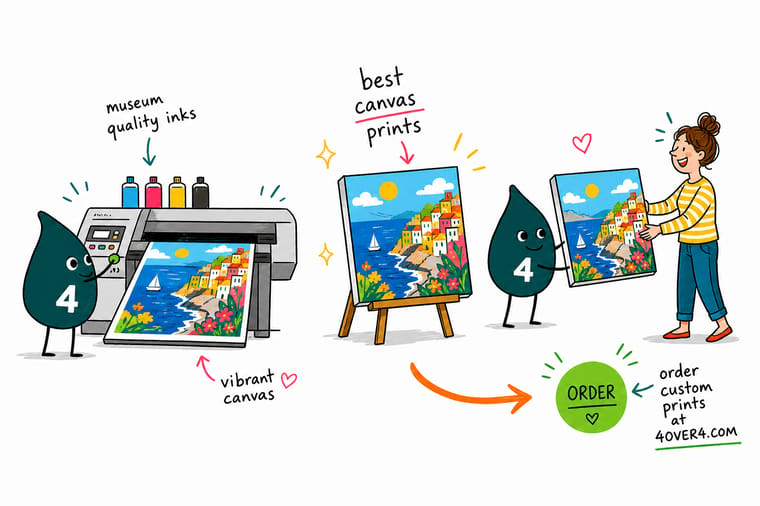
Use a heavy poly cotton canvas stretched tight enough that it springs back under a fingertip, pigment ink under a protective coat, and a file that holds 150 PPI at the finished size. Keep faces, horizons and text at least an inch and a half inside the edge so the gallery wrap has something to fold, mirror the edge when the crop is tight, and hang the piece off any wall that catches direct sun.
Order canvas prints →What to remember about canvas wall art
Practical tips before you send the file
- Decide the wrap before you crop. Whatever folds around the bars vanishes from the front. Give the subject an inch and a half of breathing room on every side and the fold has something to take.
- Size to the wall, not to the file. Measure the space, choose the finished size, then check the pixels support it. Doing it the other way round is how people end up with a print that fits nothing.
- Lift the shadows before you send it. Matte canvas reflects rather than emits, so shadow detail that reads on a screen closes up on the wall. Brighten slightly and judge in the room.
- Mirror the edge when the crop is tight. A mirrored edge costs you nothing from the image and looks deliberate. A solid black or white edge is the second safe option.
- Print one before you print six. A single premium canvas at $59 tells you more about color, crop and size than any amount of on screen proofing.
Explore more
More ways to print your walls
Related products, categories and guides on 4OVER4.COM, one card each, so you can keep planning the room.
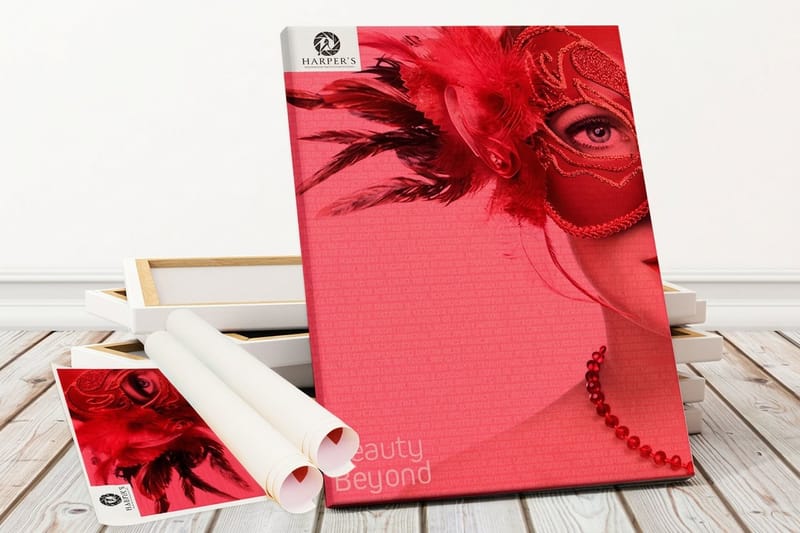
 Product Premium Canvas Prints Gallery wrapped canvas on solid bars, from $59.
  Product Square Canvas Prints One to one crops for grid walls and photo sets.
  Product Ready Made Prints Preset sizes from $15.00 for testing a wall layout.
  Category Canvas Printing Every canvas size, wrap and depth in one place.
 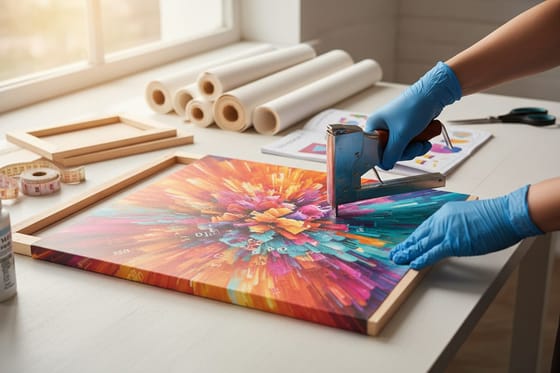 Guide What Are Canvas Prints How the weave, the coating and the bars work together.
 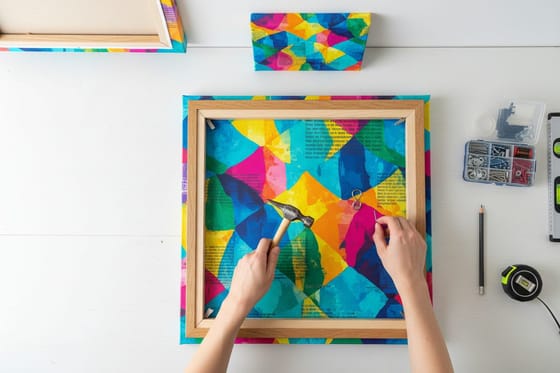 Guide How to Frame Canvas Prints Floater frames, depths and what fits a gallery wrap.
 Ready to print your wall art?
Pick the size, upload your file, and 4OVER4.COM prints it on premium canvas stretched over solid bars, wrapped the way you choose.
Common questions about canvas wall art
What resolution do I need for a large canvas print?
Target 150 PPI at the finished size and treat 100 PPI as the floor for large pieces that people view from across a room. Divide each pixel dimension by the PPI to get inches: a 4000 by 3000 pixel photo is 26.7 by 20 inches at 150 PPI, or 40 by 30 inches at 100 PPI. Canvas is more forgiving than paper because the weave already breaks up the surface and hides softness that would show on a smooth sheet. Sending a 300 PPI file does not make a canvas sharper, it only makes the upload larger, because the ink cannot resolve detail finer than the weave it sits on.
Will a canvas print fade?
Pigment ink under a protective coat holds its color for years in normal indoor light, and the thing that ages a print early is almost always direct sunlight rather than the ink or the canvas. A few hours a day of unshaded sun will shift a print regardless of how it was made, so move the piece to a wall that gets indirect light. Hot halogen spotlights placed close to the surface are the other culprit; LED washes run cooler. Dust with a dry microfiber cloth and never use a cleaning spray, because solvent takes the protective coat off before it touches anything else.
Should I choose a gallery wrap or a framed canvas?
Choose a gallery wrap when the image has room to spare around the subject and you want the piece to read as an object with a shadow line under it. Choose a frame when the crop is tight, when the room already has framed work you want it to sit alongside, or when you want a visual border between a busy image and a busy wall. A floater frame gives you both, since the canvas keeps its wrapped edges and sits inside a moulding with a small reveal around it. If you are going that route, plan the frame at the same time as the canvas so the depths match.
Is canvas or acrylic better for a photograph?
It depends on the photograph and the light in the room. Canvas has no glare at all, which makes it the reliable pick for a wall opposite a window, and the weave flatters portraits, landscapes and anything painterly. Acrylic holds far more detail and depth, and it is the better surface for saturated color, night photography and glossy product shots, but the gloss face reflects whatever is behind the viewer. Tight black and white work with delicate mid tone gradation is the clearest case where canvas loses, because the weave breaks the tonal steps into small facets.
Why does my canvas look darker than it did on my screen?
A screen emits light and a print reflects it, so a monitor shows a wider tonal range than any reflective surface can reproduce. Matte canvas has the shortest range of the wall art formats, which is the trade you make for having no glare, and the loss shows up first in the shadows where separate dark tones collapse into one mass. Lift the shadows and raise overall brightness slightly before you send the file, and judge the result under the light in the room where it will hang rather than at your desk. Printing one small piece first is the cheapest way to calibrate your eye.
