
Why Printed Water-Activated Tape Wins the Shipping Box


What Water-Activated Tape Is and How the Bond Forms
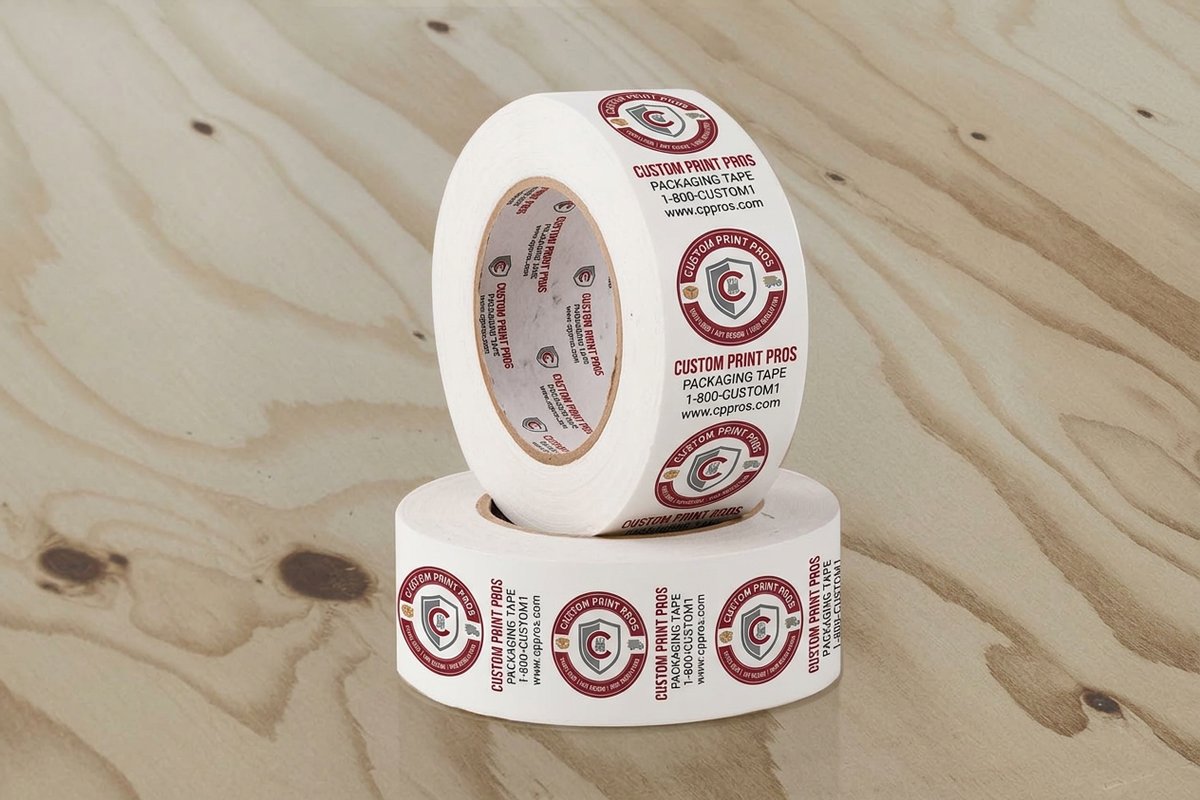
Water-activated tape, still called gummed tape on most warehouse floors, is a strip of kraft paper coated on one side with a dry adhesive that does nothing at all until it meets moisture. Run it through a wetting dispenser and the coating turns tacky, grabs the carton, and then dries into a bond that behaves less like tape and more like a repair to the box itself.
That difference matters more than it sounds. Pressure-sensitive plastic tape sits on the surface and holds by tack alone, which is why a fingernail under one corner can start a peel. Gummed tape sinks into the fiber, so removing it means destroying the top liner of the corrugated board.
Shippers usually discover it in one of two ways. Either a fulfillment lead gets tired of cartons popping open in transit, or a brand team realizes that the tape is the widest uninterrupted piece of print on the whole parcel and nobody is using it. Both roads lead to the same place, which is a printed paper tape that seals hard and carries a logo at the same time. If you are weighing branded packaging more broadly, our roundup of custom business tape covers the wider format picture.
The kraft carrier
The backing is machine-glazed kraft paper, smooth on the print side and slightly toothy on the glue side. Heavier basis weights resist tearing on the dispenser blade and hold ink crisply, which is why cheap thin gummed tape often looks blurry and jams the machine.
The starch adhesive
Most gummed tape uses a vegetable starch adhesive rather than a synthetic acrylic. Starch is water soluble in the roll and water resistant once cured, and it happens to be the same family of chemistry that holds the corrugated flutes together, which is exactly why the two bond so willingly.
Water and pressure
A dispenser wets the strip and cuts it to a preset length. Press it down firmly along the seam, smooth outward from the middle, and wrap at least two inches onto each end flap. The grab happens in seconds, but the real strength arrives as the moisture migrates into the board.
The cure
Give the sealed carton a short rest before stacking. Within minutes the adhesive has set into the top liner and the seam is effectively one piece. This is also why gummed tape holds in cold trailers and dusty warehouses where acrylic film tape tends to let go at the edges.
Shop the category
Packaging printing collection
Tape, wrap, and shipping print that all carry the same artwork.
Why Gummed Tape Seals Tighter Than Plastic Film
Ask a packing team why they switched and you rarely hear a sustainability answer first. You hear that boxes stopped arriving open. A fiber bond does not care about dust on the flap, about a carton that was stored cold, or about a recycled liner with a slightly waxy face, all of which quietly undermine pressure-sensitive film.
The practical win is speed. Instead of three wraps and a tug on a gun that skips, one measured strip lands on the seam and the carton is done. Teams pairing it with Printed Packaging Tape from $347.11 usually find that packers close boxes faster even while the seal itself is stronger, and the branded surface arrives free.
- It bonds instead of clinging. Starch penetrates the liner, so shear and peel strength both come from the board, not from surface tack.
- It survives temperature swings. Cold trailers and hot yards make acrylic adhesives brittle or gummy. A cured paper seal barely notices.
- It handles recycled corrugated. Boxes with high recycled content have dustier, less uniform faces, which is exactly where film tape lifts first.
- It needs one pass. A single strip that laps the end flaps replaces the two or three wraps most teams use to feel confident.
- It cannot be quietly reopened. Any attempt to lift the seal shreds the kraft and the liner underneath, leaving visible evidence.
None of this makes plastic tape useless. Poly mailers, shrink film, and non-porous surfaces still need a pressure-sensitive product, and plenty of operations run both. The rule of thumb is simple. If the surface is porous paperboard, gummed tape wins. If it is plastic, it will not bond at all, so reach for a conventional Packaging Tape instead.
Print picks
Three tape formats worth comparing
Live starting prices, ready to configure with your artwork.
Printed Packaging Tape From $347.11 Your logo repeating down the roll so every carton leaves the dock branded. 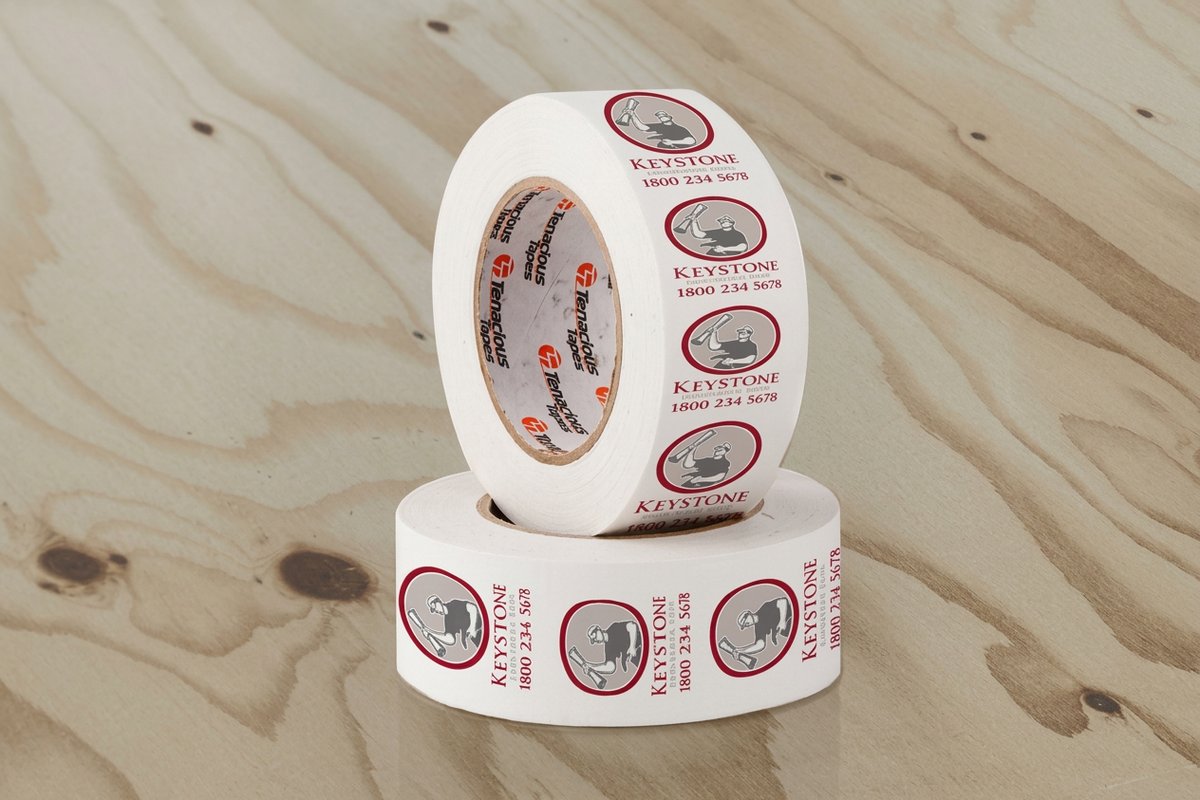 Packaging Tape From $347.11 Straightforward sealing tape for busy fulfillment benches and stockrooms.
 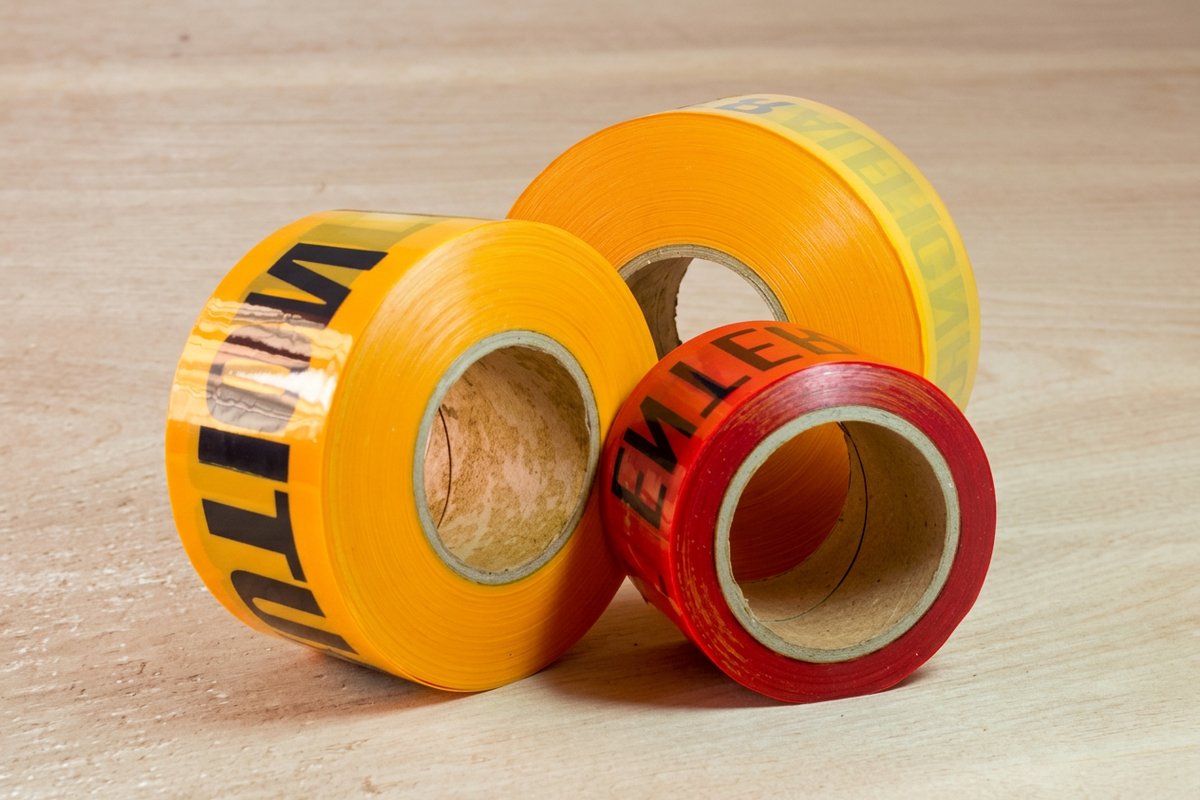 Barricade Tape From $115.33 High visibility printed tape for job sites, staging zones, and event control.
 Where Printed Packaging Tape Earns Its Keep
The strongest case for printed tape is subscription and direct-to-consumer shipping, where the box is the only physical contact a customer has with the brand between clicking buy and opening the lid. A plain brown carton with a printed seal running its length reads as deliberate. A carton wrapped in clear tape reads as a warehouse afterthought.
Food and beverage shippers use it for a second reason, which is that a paper seal signals nothing has been opened since the kitchen. Our food and cookie packaging guide walks through how sealing choices interact with inserts, liners, and shelf presentation. Service businesses that ship parts, samples, or replacements use printed tape the way they use branded office supplies, as a low cost reminder of who did the work.
- Ecommerce fulfillment. One tape SKU brands every carton size you ship, no custom box tooling required.
- High value or theft-prone goods. Electronics, supplements, and collectibles benefit from a seal that documents interference.
- Food and perishable shipping. A paper seal supports the same clean, food-safe story as the packaging inside.
- Wholesale and case packing. Printed tape doubles as case identification when the logo and a short line of copy repeat down the roll.
- Events, sites, and staging. Different job, same idea. Printed Barricade Tape from $115.33 marks zones the way sealed cartons mark ownership.
Mark the zone
Printed barricade tape
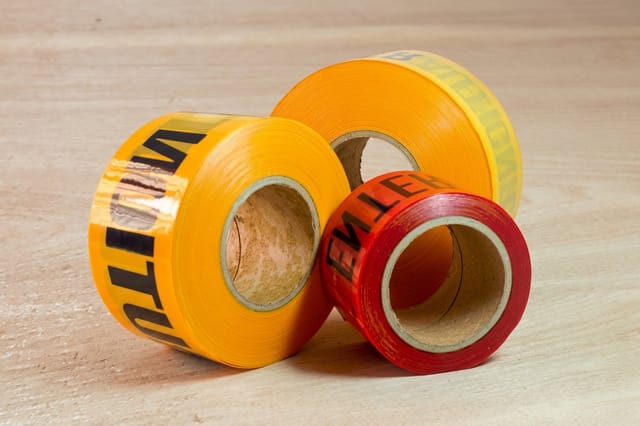
Same repeating print logic, different job. Custom copy along the roll for sites, staging areas, and events.
Designing Tape Artwork That Reads at Speed
Tape artwork is a repeat pattern, not a poster. Nobody controls where the dispenser cuts, so every design decision has to survive being sliced at a random point. The test is straightforward. Cover the artwork with two fingers, slide them along, and check that whatever shows through the gap still identifies the brand.
Kraft is the background, and it is warm brown rather than white, so colors shift. A cool blue prints muddier than the swatch suggests, and pale tints all but disappear. Bold, saturated ink in one or two colors is doing the real work here. The same discipline applies to any printed surface with a natural stock, which is why the thinking overlaps with printed deli paper and food wrap.
- Repeat the mark every few inches. A short cycle guarantees a full logo on even the shortest dispensed strip.
- Keep type large and simple. Tape is read in motion, on a moving belt or a doorstep. Fine serifs and thin weights vanish.
- Respect the edges. Leave clear margins on both long edges so slitting tolerance never clips a letterform.
- Design around the kraft. There is no white ink behind your color, so treat the brown as a deliberate part of the palette.
- Alternate elements. Logo, then a short line, then a symbol, keeps a long strip from looking like wallpaper.
One more habit that saves a reprint. Print your proof at full size, tape it across an actual carton you ship, and look at it from six feet away. Everything that felt clever at 400 percent zoom either survives that test or it does not.
- Check it upside down. Half your cartons will be seen from the other side.
- Check it cut mid-logo. If a half logo looks broken rather than cropped, tighten the repeat.
- Check it against a wet finger. Ink on the print side should never smear when the adhesive side is activated.
Sizes, Stocks, and Reinforcement Grades
Gummed tape comes in a narrower range of widths than plastic film because the format is built around a dispenser throat. Three inches is the workhorse for standard cartons, with narrower rolls used for small parcels and wider rolls for heavy cases. Roll length is quoted in feet rather than yards, and a single roll seals far more cartons than the equivalent film roll because you are using one strip instead of three.
The bigger decision is reinforcement. Plain kraft is fine for light and medium loads. Reinforced tape sandwiches fiberglass filament between two paper plies, and that filament is what stops a heavy carton from tearing through its own seal. If a box would hurt to drop on your foot, specify reinforced. For exact stock and quantity options on the printed program, the configurator on Printed Packaging Tape lists what is currently available.
- Plain kraft. Light parcels, apparel, and anything under roughly twenty pounds. Cleanest print surface of the three.
- Reinforced kraft. Heavy, dense, or long cartons. The filament carries the shear load so the paper does not have to.
- Narrow widths. Small mailers and cartons where a three inch strip would wrap past the flap edges.
- Ink count. One color is the value play. Two or three colors let a logo keep its real palette on kraft.
- Print orientation. Decide early whether artwork runs along the roll or across it, because it changes the repeat entirely.
Quantity and price
Printed packaging tape pricing and specs
Real configurator numbers. Setup spreads across the run, so volume moves the per unit cost.
| Quantity | Price Per Unit | Total |
|---|---|---|
| 1 | $347.11 | $347.11 |
| 2 | $302.40 | $604.80 |
| 5 | $272.53 | $1,362.67 |
| 10 | $233.28 | $2,332.75 |
| 20 | $189.39 | $3,787.89 |
| 30 | $176.79 | $5,303.65 |
Tamper Evidence Your Customer Can Actually See
Tamper evidence is the quiet reason a lot of operations move to paper tape and never move back. Film tape can be warmed, lifted at a corner, peeled off in one piece, and pressed back down by anyone with patience. The carton arrives looking untouched, and the loss shows up later as a customer dispute nobody can resolve.
A cured gummed seal removes that ambiguity. Lifting it pulls fiber off the liner, so the box shows a torn, fuzzy scar wherever the tape was disturbed. Add a printed design and the evidence gets stronger still, because a replacement strip of generic tape is obvious against a branded seal. That is the same logic behind putting your identity on things people handle daily, from Packaging Tape to printed paper cups.
- Run the strip onto the flaps. Two inches down each end panel means a thief cannot slit only the seam.
- Print an alignment element. A continuous rule or stripe makes a mismatched resealing attempt visible instantly.
- Photograph the seal at dispatch. With printed tape the image is unambiguous evidence of condition on leaving your dock.
- Train the unboxing message. Tell customers what an intact seal looks like and reports of interference get far more reliable.
Stock the bench
Packaging tape specs
The everyday sealing roll, with the full spec sheet for widths and quantities.
Recycling, Kraft, and the Honest Sustainability Case
The environmental argument for paper tape is real but narrower than the marketing suggests, so it is worth stating plainly. A kraft carton sealed with kraft tape goes into the paper stream as one item. Nobody has to peel plastic off first, and the starch adhesive repulps alongside the fiber rather than surviving as contamination.
That is the whole claim, and it is a good one. What it does not mean is that gummed tape is automatically lower impact in every dimension, because reinforced grades contain filament and printing adds ink either way. If your customers care about this, say something accurate on the box rather than something sweeping. Brands that carry that consistency through to reusable branded bottles and branded workwear tend to get the most credit for it.
- Plain kraft is the cleanest story. No filament, no film, curbside with the carton in most municipal programs.
- Reinforced tape still recycles in most mills, though the filament is a contaminant some facilities screen out. Check locally before you print a claim.
- One strip is less material. Replacing three passes of film with one paper strip cuts packaging weight per carton on its own.
- Skip the plastic void fill mismatch. A recyclable seal on a box full of foam peanuts undercuts the entire message.
What Printed Water-Activated Tape Costs
Printed tape is priced as a print run, not as a shelf item, which surprises buyers coming from a box store. You are paying for a plate or cylinder setup, the ink colors, the kraft stock, and the total footage, and the setup portion is spread across whatever quantity you order. That is why the per-roll number falls steeply as volume rises while the first order always looks like the expensive one.
On 4OVER4.COM, Printed Packaging Tape starts at $347.11 and unprinted Packaging Tape starts at $347.11, while printed Barricade Tape starts at $115.33. Live tiers sit in each configurator, so the fastest way to price a program is to enter the width and quantity you actually run in a quarter.
- Ink count moves the number most. One color on kraft is the efficient choice, and two colors is the usual upgrade point.
- Order in quarters, not weeks. Tape stores well, and consolidating runs is where the real savings live.
- Standardize the width. One width across all carton sizes keeps a single SKU on the shelf and a single price tier.
- Compare cost per carton, not per roll. One strip per box against three passes of film changes the math completely.
Compare options
Popular packaging print, side by side
Stock, size, quantity, turnaround, and starting price in one view.
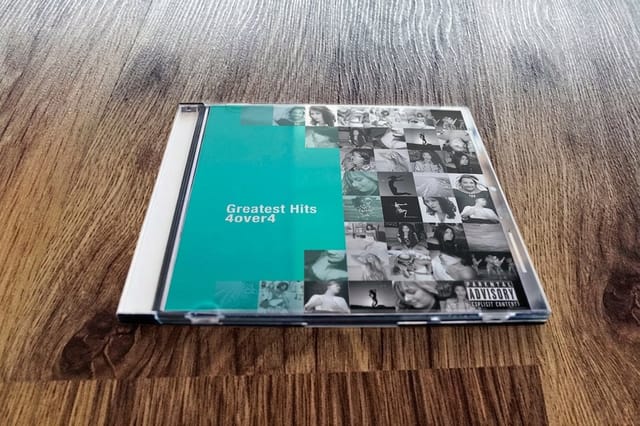 Cd Covers | 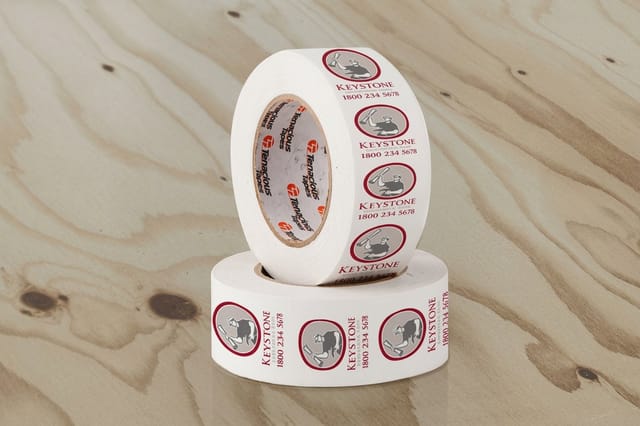 Packaging Tape | 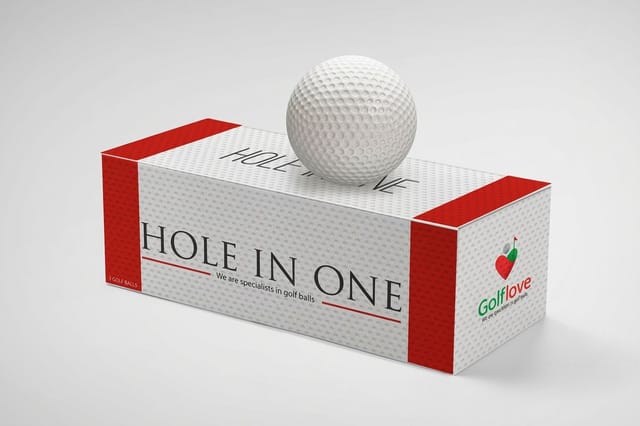 Golf Ball Boxes |  Header Cards | |
|---|---|---|---|---|
| Min price | $75.80 | $347.11 | $269.11 | $218.30 |
| Paper / stock | 100# Gloss Text | - | 14pt Uncoated Cover | 14pt Uncoated Cover |
| Finish | Standard Finish | - | Standard Finish | Standard Finish |
| Size | 4.75" x 4.75" Single Panel | 2" x 55 Yard Tape (36 rolls/case) | 1.7" x 1.7" x 5" | 3.5" x 4" scores to 3.5" x 2" |
| Default qty | 25 | 1 | 50 | 1,000 |
| Turnaround | 5 business days | 20 business days | 7 business days | 6 business days |
| Rating | ||||
| View & customize | View & customize | View & customize | View & customize |
Ordering, Turnaround, and Getting It Onto the Line
Lead time on printed tape runs longer than on flat print because the artwork has to be set up as a repeat and the run is a converting job. Plan on ordering ahead of your season rather than into it, and hold enough plain tape to cover any gap so packing never stops while a branded run is in production.
Upload press-ready art in vector form with fonts outlined, colors specified as spot values, and a clearly marked repeat length. Approve the proof against a real carton rather than a screen. If you are building a whole branded packaging program at once, the packaging printing collection shows what else can carry the same artwork.
Get the dispenser right
- Manual dispensers suit a bench packing a few dozen cartons a day and cost very little to start with.
- Electric dispensers pay for themselves quickly above a few hundred cartons a day by cutting to a preset length every time.
- Water level matters. Too little and the seal releases, too much and the kraft wrinkles and the print softens.
- Set the length once. Carton width plus four inches gives you the two inch lap on each end flap that makes the seal tamper evident.
Start fast
Templates and print-ready blanks
Free layouts plus exact-size blanks so your repeat lands on the roll correctly the first time.

Wally explains the gummed tape seal
Wet it, press it, and the box seals itself shut
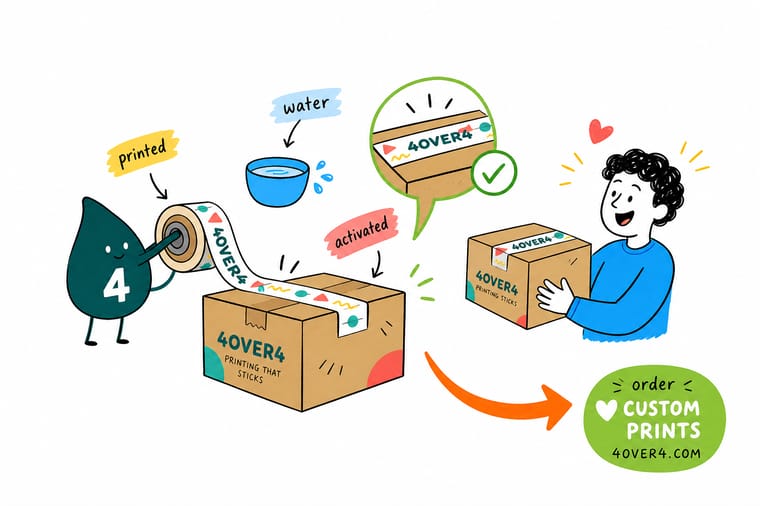
Think of gummed tape as a repair rather than a wrapper. The starch adhesive wakes up when it meets water, sinks into the corrugated liner, and dries into the board. That is why one strip beats three passes of plastic, why cold trailers stop popping cartons open, and why anyone who lifts the seal leaves a torn kraft scar behind. Print your logo on it and the strongest seal on the box is also the widest piece of branding.
Design your printed packaging tape →What to Lock In Before You Order Tape
Explore more
More ways to brand what you ship
Related pages across 4OVER4.COM, one card each.
 Article 9 Ecommerce Packaging Solutions That Protect Orders and Sell Your Bran Compare 9 ecommerce packaging solutions on cost, protection, and unboxing appeal, from mailers to printed inse
 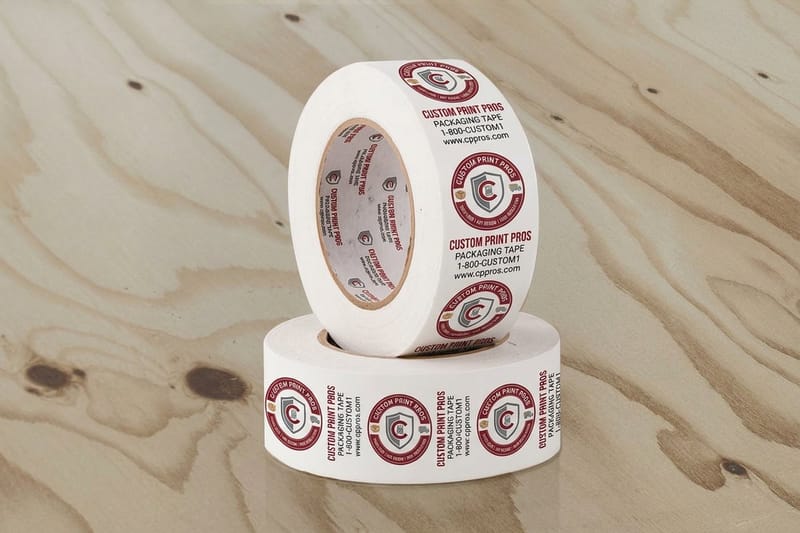 Product Printed Packaging Tape Your artwork repeating down the roll on every carton you ship.
  Collection Packaging Printing Tape, wrap, boxes, and labels that carry one look. Product Packaging Tape Dependable sealing tape for high volume packing benches. Guide Food and Cookie Packaging Guide Sealing, liners, and presentation for edible goods.
 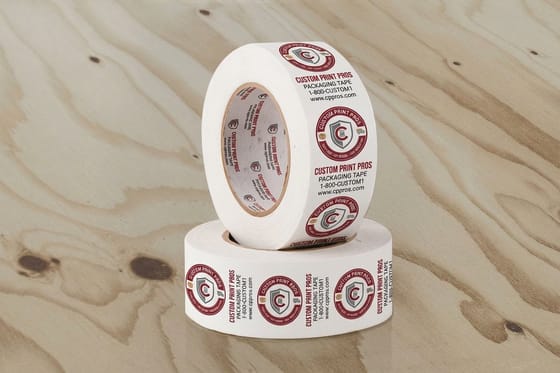 Article Custom Business Tape The wider format picture for branding every shipment.
 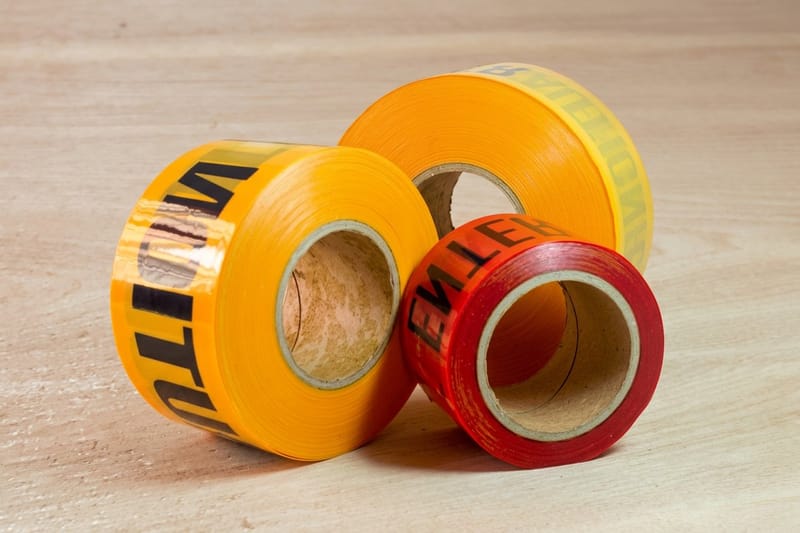 Product Barricade Tape High visibility printed tape for sites and staging areas.
  Article Custom Deli Paper and Food Wrap Printing on natural stocks where kraft is the palette.
  Article Custom Printed Paper Cups Branding the objects customers physically hold.
  Article Custom Branded Office Supplies Low cost items that keep your name in front of clients.
  Article Custom Branded Water Bottles Reusable branding that travels past the unboxing.
  Article Custom Workwear and Uniforms Carrying the same identity onto the people packing boxes.
 Ready to put your name on every carton you seal?
Set the width, pick your ink colors, and upload a repeat that survives the cut. The tape that holds the box shut can carry your brand at the same time.
Printed Water-Activated Tape FAQ
What is printed water activated tape?
It is kraft paper tape coated with a dry starch adhesive that only becomes sticky when it is wetted, with your artwork printed in a repeating pattern along the roll. A dispenser moistens and cuts the strip, the adhesive soaks into the corrugated liner, and within minutes the seal has bonded into the board rather than sitting on top of it. Warehouses often call it gummed tape. See it in action on Printed Packaging Tape.
How do I choose the right printed water activated tape?
Start with the load. Plain kraft handles light and medium cartons, while reinforced tape with fiberglass filament is what you want for heavy, dense, or unusually long boxes. Then pick a width that laps onto the end flaps of your most common carton, settle on one or two ink colors that stay bold against brown kraft, and confirm you have a dispenser that wets consistently. Standardizing on a single width across all your box sizes keeps ordering simple.
What does printed water activated tape cost and how are prices set?
Printed tape is priced like a print run rather than a shelf item, so the quote combines setup for your artwork, the number of ink colors, the stock, and total footage. On 4OVER4.COM, Printed Packaging Tape starts at $347.11, unprinted Packaging Tape starts at $347.11, and printed Barricade Tape starts at $115.33. Per unit cost drops sharply with volume because setup spreads across the run, so quote a quarter of usage at a time.
What sizes, stocks and finishes are available for printed water activated tape?
Widths are built around dispenser throats, with three inches serving as the standard for regular cartons and narrower rolls covering small parcels. Stock choices come down to plain kraft or filament reinforced kraft, and both take flexographic ink well. Artwork can run along the roll or across it, one to three colors, with the natural brown kraft acting as your background since there is no white underprint. Current options are listed in the product configurator.
How long does printed water activated tape take to print and ship?
Printed tape takes longer than flat print because the artwork has to be set as a repeat and the roll has to be converted after printing, so treat it as a planned reorder rather than a rush item. Submit vector artwork with fonts outlined and spot colors specified, approve the proof against a real carton, and keep enough plain tape on hand to cover the gap. Live turnaround options appear in the configurator once you select width and quantity.
