
How to Estimate Printing Costs Before You Place an Order


What actually sets a print price, why the per-piece figure falls so fast at the start of a run, and a four step method for pricing your own job before you spend anything.
A printing estimate is your quantity multiplied by a per-piece price that falls steeply as the run grows, adjusted for size, stock, printed sides, finishing and how fast you need it. There is no universal rate card, so the quickest accurate number comes from setting those options in the product configurator and reading the live total, then changing one option at a time to see what each is costing you. Shipping and the delivery date sit outside that price and belong in the estimate too.

Quick answer
Fixed setup, divided by your quantity, plus everything you add after the press
Print is priced per configuration, not from a formula. A fixed block of setup work happens once for the whole run, so dividing it across more pieces is what makes the per-piece price fall, quickly at first and then hardly at all. On top of that sit the choices you make: the trim size, the stock, whether it prints one side or two, every finishing step after the press, and the turnaround that decides where your job sits in the queue. Configure the job, note the total, then change one variable at a time. That is the estimate.
The Five Choices That Set Your Print Price
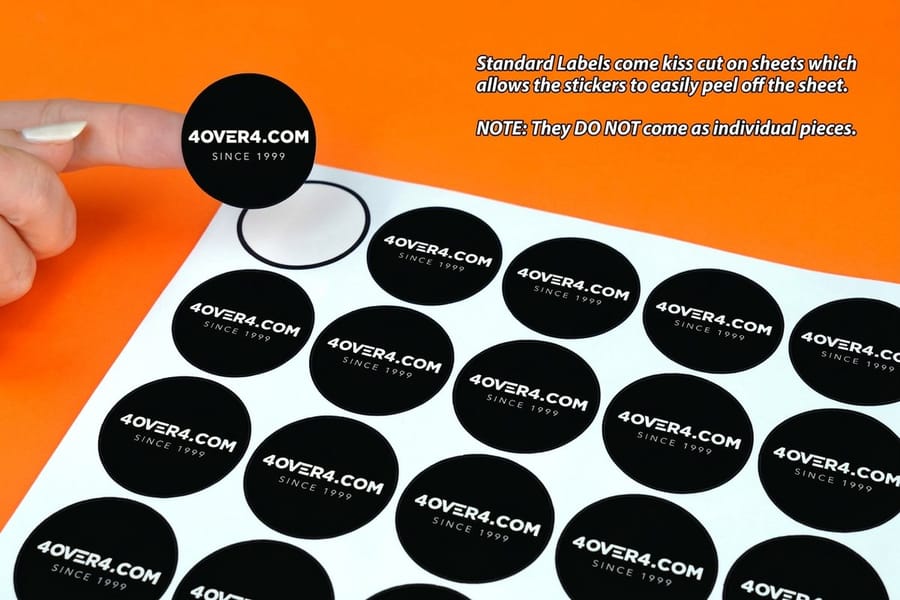
Every print quote comes down to the same short list, and once you can see which item is doing the damage you can usually fix it in a minute. Quantity, size, stock, what happens after the ink dries, and how fast you need it.
| What you choose | How it moves the price | How big the swing is | When to decide it |
|---|---|---|---|
| Quantity | Spreads the fixed setup across more pieces, so the per-piece price falls fastest at the low end. | The largest lever you control. | Last, after the spec is settled, so you can compare two runs of the same job. |
| Size | Standard trim sizes share a press sheet with other work. Custom sizes and shapes need their own sheet or a die. | Small inside the standard list, large the moment you leave it. | First. Everything else is priced against the size. |
| Paper or substrate | Heavier stock costs more per sheet, and coated, uncoated and synthetic materials sit at different price points. | Moderate, and predictable. | First, with the size. Order samples if you are unsure rather than guessing from a screen. |
| Sides and finishing | A second printed side adds a pass. Foil, spot gloss, die cutting, folding and scoring each add a step after the press. | Moderate to large, depending on how many steps you stack. | Middle. This is where a design decision quietly becomes a budget decision. |
| Turnaround | Buys a place further forward in the production queue, and sometimes a faster carrier service behind it. | Large at the fast end. | Before you configure. A date set afterwards can erase every saving you just made. |
Read the last column first. Size and stock are decisions you make once, quantity is the one you tune, and turnaround is the one people leave until the end and then pay for. If the job is a banner, the whole calculation changes shape because wide format is priced by area rather than by piece, which is covered in our guide to ordering large banner printing.
Why the Second Five Hundred Always Costs Less Than the First
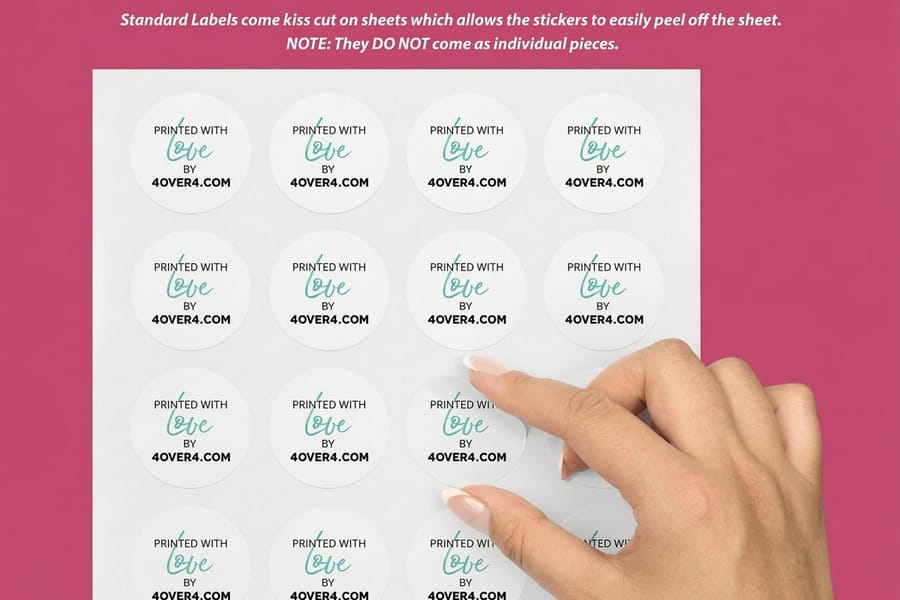
The single most useful thing to understand about print pricing is that a big part of the cost happens before a single good sheet comes off the press. Files are checked and imposed, plates or a digital setup are made, the press is brought up to colour, and a few sheets are wasted getting there. That work is the same whether the run is 250 pieces or 2,500.
So the per-piece price is the fixed setup divided by the quantity, plus the paper and press time for each additional piece. Divide a fixed number by a bigger number and the result falls quickly at first, then flattens out and approaches the material cost, which it can never go below. That curve is the whole story, and it explains two things at once: why 500 business cards cost so much more per card than 5,000, and why jumping from 5,000 to 10,000 barely moves the per-card figure.
The trap sits at the flat end. Once the curve has levelled off, a larger run is buying you a very small saving per piece for a real increase in the total, and you are betting that the address, the phone number, the price list or the promotion on the piece will still be correct when you get to the bottom of the box. Print what you will genuinely use in the next few months, then reprint. Stationery and anything with a date on it is where over-ordering goes wrong most often.
Where the logic reverses is on jobs that share one setup across several pieces. Printing four postcard designs at 500 each as one job with a common size and stock is cheaper than four separate orders, because the setup is shared. If you have several small pieces coming up, gang them into one order. The same thinking applies to booklet printing, where page counts in multiples of four use the press sheet without waste.
Estimating a Real Job in Four Steps

Here is the sequence that gets you to a reliable number without guessing. It takes about ten minutes and the last step is the one most people skip.
- Define the deliverable, not the product. How many people need to hold it, and by what date. Two hundred labels for a product launch and two thousand for a season are different jobs with different economics, and the date decides which turnaround you are allowed to pick.
- Lock size and stock from the standard list. Choose the closest standard size before you consider a custom one. If the custom size is worth it you will see exactly what it costs in step three, and you will be comparing against a real baseline instead of a feeling.
- Configure it and read the live price. Set your options on the product page and note the total. Then change one thing at a time, quantity first, then stock, then turnaround, writing down what each swap does. Ten minutes of this teaches you more about your own job than any rate card.
- Add shipping and check the date. Take the configured total, add the shipping quote at checkout, and confirm the delivery date lands before the day you need it. Then stop. A price that arrives late is not a saving.
Starting prices are the anchor for step one, and they vary far more by product type than most people expect. These are live starting prices at 4OVER4.COM, with the variable that moves each one hardest.
| Product | Starting price | What moves the price most | The cheapest way to bring it down |
|---|---|---|---|
| T Shirt | $21.96 | Quantity and the number of print locations. | One location, one run, everyone ordered together. |
| Standard Labels | $23.88 | Quantity, then material and shape. | A standard rectangle on standard stock, ordered in one run. |
| Greeting Cards | $56.02 | Quantity, stock weight and whether it folds. | A standard folded size and one paper choice across the set. |
| Outdoor Banners | $79 | Square footage, since wide format is priced by area. | Trim the dimensions before you trim anything else. |
| Scratch Off | $237.25 | The scratch-off panel, which is a finishing step on top of the print. | Fewer panels, standard card size, one run. |
Notice that four of the five are moved most by quantity and one is not. Banners are billed by area, so a 3 by 6 foot banner and a 4 by 8 foot banner are genuinely different jobs even at the same quantity. If your budget is fixed, shrink the banner before you cut the count. For a sense of how our finishing steps stack up in practice, the scratch-off printing article walks through what that extra panel involves.
Where Estimates Break, and the Coverage Myth

Most estimates go wrong in the same handful of places, and none of them are the printing itself.
- Shipping was never counted. The configured price produces the job. A heavy or bulky order can move the landed total more than any print option you changed, so quote it before you commit.
- The date was set after the budget. Turnaround gets chosen last, at which point the fast option costs whatever it costs. Decide the date first and configure against it.
- A custom size crept in. A trim size that is a quarter inch off a standard one delivers no visible benefit and pushes the job off the shared press sheet.
- The file caused a second run. Missing bleed, low resolution artwork or type outside the safe area is the most expensive mistake on this list, because the fix is a reprint. Start from a correctly sized layout and check it before you upload.
- Nobody saw the stock first. Paper looks different in the hand than on a screen. Ordering samples before a large run is the cheapest insurance available, and our guide to ordering free samples covers how to get them.
Then there is the myth worth naming, because it wastes design time. Heavy ink coverage does not raise the price of a commercial print job the way it raises the cost of a page from an office printer. A four colour press lays down all four inks on every sheet regardless of how much of the page they cover, so a solid navy flood and a small black logo cost the same to run. Toner and desktop inkjet bill you by coverage. A press bills you by time on the machine.
Coverage does still matter, just not on the invoice. Dense solids show mottling more readily on uncoated stock, ink over a fold can crack unless the piece is scored properly, and a heavy flood on a light sheet can show through from the reverse. Those are reasons to move up a stock weight or add a coating, both of which you can price in the configurator alongside everything else. For the wider picture of how a print order moves from file to delivery, start at our printing basics guides and the turnaround and order tracking guide.
Wally prices a job
One setup, divided by however many you print
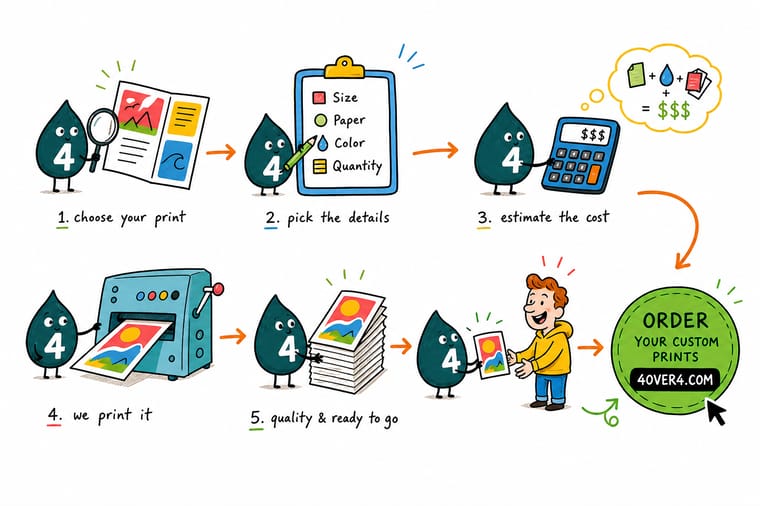
Wally does the setup once. Files checked, plates made, press brought up to colour, a few sheets wasted getting there. That work costs the same whether he prints 250 or 2,500, so every extra piece splits the bill further and the per-piece price drops fast, then flattens out near the cost of the paper. His advice across the counter: push the quantity up while the curve is still steep, keep the size and stock standard so your job shares a press sheet, and pick your delivery date before you configure anything, because a rush option chosen last undoes every saving you made first.
Configure standard labels and see the price →Specs and pricing
Price three real jobs, side by side
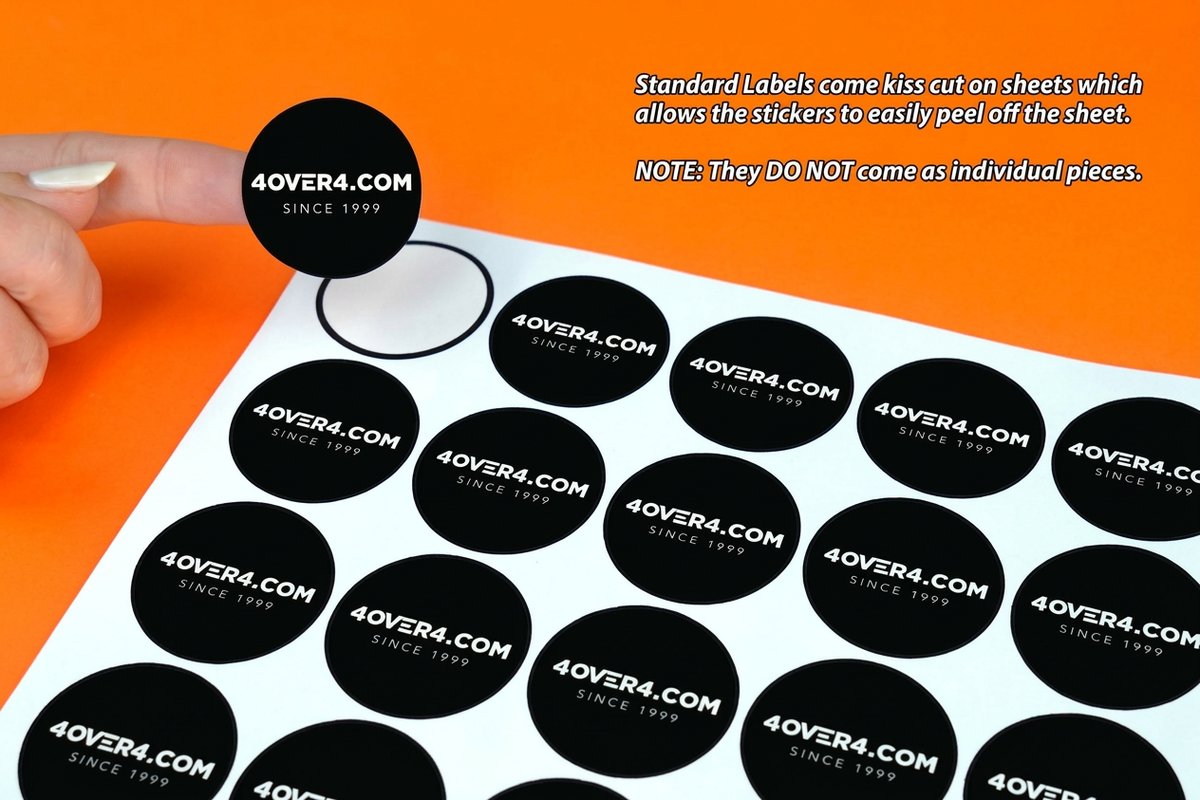
Set quantity, size, stock and turnaround on each one and watch the total move. Configuring the same job twice with one variable changed is the fastest way to learn what your own print budget is actually buying.


Print it
Start from a live price, not a guess
Explore more
Where to go next






By the numbers
Pricing you can plan around at 4OVER4
Common Questions
Your printing cost questions, answered
How do I get an exact printing price instead of an estimate?
Open the product page and configure the job. Every 4OVER4.COM product carries a live configurator where you set quantity, size, stock, sides, finishing and turnaround, and the price updates as you go. That number is the real price for that exact specification, not a bracket. Treat any figure you work out on paper as a planning number and the configured total as the price you will pay, because the two differ most on custom sizes and specialty finishes.
Does ordering a larger quantity always bring the per-piece price down?
It always brings it down, but not always by enough to matter. The steep part of the curve is at the beginning, where the fixed setup is being shared across a small number of pieces. Once the run is large, most of what is left is paper and press time, so the extra thousand saves you very little per piece and costs you real money up front. The practical test is whether you will use the extra pieces before the information on them goes out of date.
Does heavy ink coverage make a print job more expensive?
On a commercial press, almost never. The job runs four color process whether the artwork is a thin logo on white or a solid flood, so the press time and the plate work are the same. What coverage does change is behaviour: solid areas look more mottled on uncoated stock, dense ink is more likely to crack along a fold, and a heavy flood on a thin sheet can show through from the back. Those are reasons to change your stock, not your budget.
How much does a faster turnaround add?
Enough to notice, and it varies by product because the bottleneck is different for each one. A fast turnaround does not make the press run quicker, it buys you a place further forward in the queue and sometimes a more expensive shipping service on the back end. Configure your job at the standard turnaround first, then switch to the faster option and read the difference. Our guide to printing turnaround times explains where the days actually go.
Is shipping included in the price I see on the product page?
No. The configured price covers producing the job. Shipping is calculated at checkout from the destination and the delivery speed you choose, which is why a heavy job like banners or a large booklet run can shift the total more than the print options did. Estimate shipping before you commit the budget, especially on anything bulky or anything going to a residential address.
Why do two printers quote different prices for the same specification?
Usually because they are not printing it the same way. One may be ganging your job onto a shared press sheet while the other runs it alone, one may be quoting digital and the other offset, and the stock named on both quotes can be a different weight or brand. Compare the specification line by line before you compare the totals, and check what each quote assumes about turnaround and proofing.
Get Started
Ready to put a real number on your job?
Set your quantity, size, stock and turnaround in the configurator and the price updates as you go. Change one option at a time and you will see exactly where your budget is going.
Legal Disclaimer
Gold Standard guarantees apply to all standard orders placed through 4over4.com. Price match requires verifiable proof of a competitor's published price for an equivalent product with matching specifications and turnaround time. Satisfaction guarantee covers manufacturing defects and print quality issues. Contact support with order number and documentation. On-time delivery rate based on tracked orders 1999 to 2026. Individual results may vary based on shipping carrier performance.
