
Standard Sticker and Label Sizes for Every Product and Package


Size follows the surface and the reading distance, not the other way around. Here are the standard sticker and label sizes by shape, the common product and packaging ranges, and how to set any of them up to print clean.
The most ordered sizes are 2x2, 3x3, and 4x4 inch squares, 3x2 and 4x6 inch rectangles, and 2 and 3 inch circles. Product labels are sized to their container, die cuts follow any custom shape, and every size needs 0.125 inch of bleed and a safe area for text.
Start here
Sticker and label sizes in one paragraph
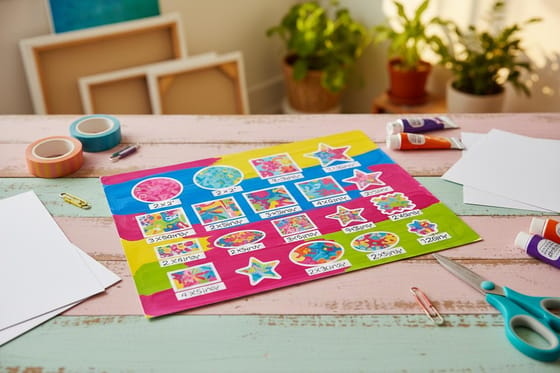
The three sizes that cover most orders are the 3 by 3 inch square sticker, the 2 by 2 inch square for small product seals, and the 4 by 6 inch rectangle for shipping labels. After that, size follows the surface and the reading distance. Squares and rectangles cover most jobs, circles and ovals suit seals and bottles, product labels are sized to their container, sheet address labels run 1 by 2.625 inches at 30 up and 2 by 4 inches at 10 up, and a die cut prints any shape you draw. Whatever you choose, add 0.125 inch of bleed and keep text in a safe area. The chart below sets the common sizes side by side, and the printable size sheet under it shows each one at actual size.
Why sticker and label size matters, and how to choose
Size is the first decision on any sticker or label, and it is easy to get backwards. The dimension should follow the surface and the reading distance, not the other way around. A sticker that is too big overwhelms the product it sits on; one that is too small gets lost or leaves no room for the information it needs to carry.
So start from where the piece will live. A laptop lid, a jar, a box panel, and a car bumper each impose a different maximum size and favor a different shape. Then consider how far away it must be legible: a shelf label read at arm’s length can be small, while a window or bumper sticker read across a room or a road has to be larger.
This guide lays out the standard sizes by shape, the common ranges for product and packaging labels, the shipping and address label sizes the carriers expect, and when a die cut beats a standard size, then shows how to set any of them up to print clean. For a quick visual reference, our sticker sizes chart pairs each size with its best use.
Standard square and rectangle sizes
Straight-edged shapes are the most ordered stickers and labels because they are simple to lay out and read cleanly. Squares run 2 by 2, 3 by 3, and 4 by 4 inches, with the 3 by 3 a reliable default for a general promotional sticker. They suit laptops, packaging, and giveaways where a balanced, contained shape works.
Rectangles run 3 by 2, 4 by 3, and 4 by 6 inches, and they shine when there is text to carry. A 4 by 6 inch rectangle is the classic address and shipping label size, with room for a name, an address, and a barcode. Narrower rectangles wrap product panels and name labels neatly.
Because straight edges nest efficiently on stock, these shapes are also among the most economical to print in volume. When your design is simple and your priority is cost and legibility, a standard square or rectangle is almost always the right call. Our custom labels and standard stickers cover the full range.
Shipping and address label sizes
Shipping and address labels are the one place where the size is decided for you. If the label feeds a thermal printer or comes out of a carrier shipping tool, the answer is 4 by 6 inches: that is what USPS Click-N-Ship, UPS and FedEx label printers output, one label up on a roll or a fanfold stack. Everything smaller is for return addresses, small parcels and sheet fed office printing, where the sheet layout matters more than the carrier.
| Label size | Millimeters | Sheet layout | Carrier fit |
|---|---|---|---|
| 4 by 6 in | 101.6 by 152.4 mm | 1 up, roll or fanfold | The size USPS, UPS and FedEx thermal label printers expect |
| 4 by 4 in | 101.6 by 101.6 mm | 1 up on a roll, 2 up on a letter sheet | Square pack out and contents labels, not a carrier default |
| 2 by 4 in | 50.8 by 101.6 mm | 10 up on a letter sheet | Return address and routing labels beside the carrier label |
| 1 by 2.625 in | 25.4 by 66.7 mm | 30 up on a letter sheet | The everyday address label, run on an office laser or inkjet |
| 3.5 by 5 in | 88.9 by 127 mm | 4 up on a letter sheet | Large address blocks and packing slips on small parcels |
Two setup notes carry over from the rest of this guide. Add 0.125 inch of bleed on every edge and keep the address block and the barcode inside the safe area, because a barcode that runs into the trim will not scan. On a 4 by 6 the barcode wants to sit across the short dimension with clear white space around it, and white matte stock reads more reliably under a scanner than a gloss face. Sheet sizes print on our custom labels; sticker shapes are on standard stickers.
Standard circle and oval sizes
Round shapes read differently from squares: a circle looks like a seal or a badge, which is exactly why it works so well on jar lids, packaging seals, and quality marks. Standard circle sizes are 1.5, 2, and 3 inches in diameter, with 2 inches the most common for a lid or a general round sticker.
Ovals soften the badge shape and wrap a curved surface more gracefully than a hard corner, which makes them a favorite for bottles, cosmetics, and artisan food products. Common oval sizes are around 2.5 by 1.5 and 3 by 2 inches. On a round container, an oval or a gently curved label follows the surface without the corners lifting.
When you are labeling anything cylindrical, think about the wrap: the label width should suit the circumference so the ends meet cleanly, and the height should fit the straight part of the panel. Our guide on wine bottle label dimensions shows how to size a label to a specific bottle shape.
Common product and packaging label sizes

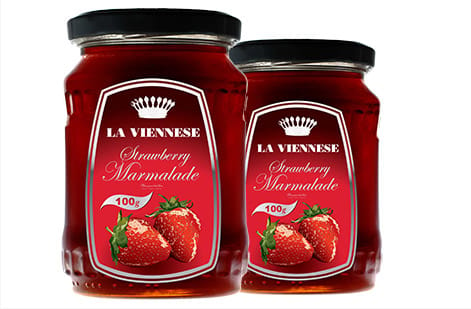
Product and packaging labels are sized to the container rather than to a fixed standard, so the right dimension is whatever fits the panel while leaving room for required information. As a rough guide, front labels on jars and bottles commonly run 2 to 4 inches wide, with the height set by the flat part of the panel, and back labels a little taller to hold ingredients or directions.
Shipping and address labels are more standardized, with 4 by 6 inches the dominant size for a shipping label and 4 by 3 or smaller for return addresses. Whatever the product, size the label so a barcode, legal copy, or nutrition panel sits comfortably without crowding, because a cramped label reads as cheap and can fail a scan.
Regulated categories like food, beverage, and health products add required panels, so build those into the size early. Our guide on choosing the correct label size walks the measurements, and our custom die-cut labels handle shapes a standard rectangle cannot.
Die cut and custom shapes, plus roll versus sheet

When a standard square or circle would leave awkward empty space around your art, a die cut is the answer. A die-cut sticker follows the exact outline of your design at any dimension you set, so a logo, a mascot, or an irregular illustration prints with no filler background and looks fully custom.
Die cutting works at any size, from a small 1.5 inch logo sticker to a large window or laptop piece, and it is the go-to whenever the shape of the artwork is part of the appeal. The tradeoff is that simple standard shapes are faster to lay out and often more economical in high volume, so match the method to the design.
Separately from shape, decide on roll versus sheet. Roll labels suit high-volume and machine application, while sheet labels and cut-to-size stickers suit smaller runs and hand application. Our guides on round versus die-cut labels and roll versus sheet labels help you decide.
Wally sizes the sticker to the surface
Shape, size, then bleed and safe area
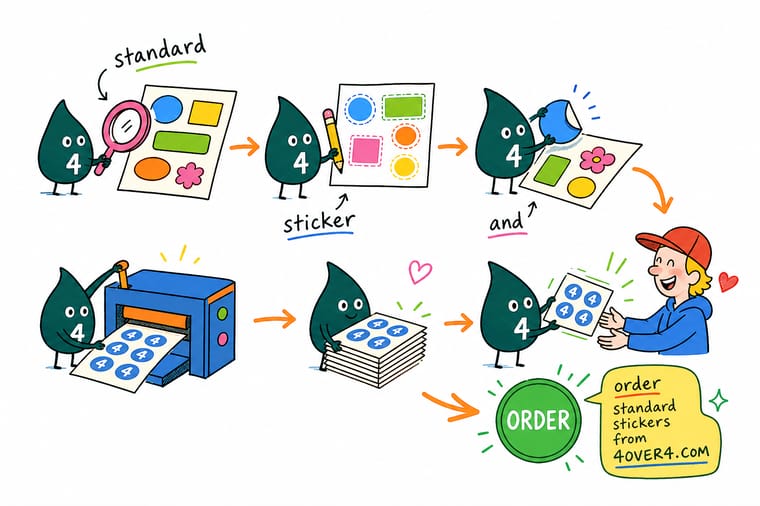
Wally measures where the sticker or label will live first, then picks the shape and size to fit: a square for a laptop, a circle for a jar lid, a die cut when the art has its own outline. He leaves room for a barcode, adds a bleed on every edge, and tucks the text inside a safe area so nothing gets trimmed. Then it prints exactly to size.
Print your stickers →Quick answers
Shipping, address and everyday label sizes, answered
What is the standard shipping label size?
4 by 6 inches, or 101.6 by 152.4 mm. It runs one label up on a roll or a fanfold stack and it is the size USPS, UPS and FedEx thermal label printers expect, with room for the name, the address and the barcode. Keep the barcode inside the safe area and add 0.125 inch of bleed if the label carries a background color to the edge.
What is the standard address label size?
1 by 2.625 inches, 30 up on a letter sheet, is the everyday address label for an office laser or inkjet. Step up to 2 by 4 inches, 10 up on a sheet, when the address block or the return address needs more room, and to 3.5 by 5 inches, 4 up on a sheet, for a large address block on a small parcel.
What are the most common label sizes?
Squares at 2 by 2, 3 by 3 and 4 by 4 inches, rectangles at 3 by 2, 4 by 3 and 4 by 6 inches, and the sheet address sizes at 1 by 2.625 and 2 by 4 inches. The 3 by 3 square is the reliable default for a general promotional sticker and the 4 by 6 rectangle is the shipping label. Whichever you pick, add 0.125 inch of bleed and keep text in a safe area. Sizes side by side are in our sticker sizes chart, and stock and quantity options are on custom labels and standard stickers.
Quick reference
Standard sizes by shape, at a glance
Match the shape to the surface, then pick a size from its common range. These are the most ordered dimensions across stickers and labels.
| Shape | Common sizes | Best for |
|---|---|---|
| Square | 2x2, 3x3, 4x4 in | The all-purpose sticker shape for laptops, packaging, and promos. |
| Rectangle | 3x2, 4x3, 4x6 in | Fits product panels and address-style labels with room for text and a barcode. |
| Circle | 1.5, 2, 3 in diameter | Reads as a seal or badge, ideal for jar lids and packaging seals. |
| Oval | 2.5x1.5, 3x2 in | A softer badge shape that wraps bottles and cosmetics well. |
| Product label | Sized to the panel | Front and back labels matched to the container, leaving room for required copy. |
| Die cut | Any custom shape | Follows the exact outline of your artwork at any dimension you choose. |
Printable size sheet. Every size below is drawn at actual size. Print this page at 100 percent with scale to fit turned off, then hold your jar, laptop lid or parcel against the boxes before you order. The outlines are the finished trim size, so add 0.125 inch of bleed outside each edge in your artwork and keep text inside the safe area.
Step by step
Pick and set up your size in 7 steps
- Start from the surface Measure where the sticker or label will go, whether a laptop lid, a jar, a box panel, or a bottle, and note any curve. The surface sets the maximum size and the shape that fits best.
- Factor in reading distance A shelf label read at arm’s length can be small, while a window or bumper sticker read from across a room or a road needs to be larger. Size the piece to how far away it must be legible.
- Pick the shape Choose a square or rectangle for most jobs, a circle or oval for seals and bottles, or a die cut when the artwork has its own outline. The shape narrows the standard sizes to choose from.
- Leave room for required information On product and packaging labels, make sure the size holds a barcode, ingredients, or legal copy without crowding. It is better to size up slightly than to squeeze.
- Choose roll or sheet Pick roll labels for high-volume application lines and machine dispensing, or sheet and cut-to-size stickers for smaller runs and hand application.
- Set up bleed and safe area Build the file at the final size, extend any edge art 0.125 inch past the cut for bleed, and keep text and logos inside a safe margin so the trim never clips them.
- Confirm and order Match your chosen size and shape to the right sticker or label product, upload your file, and let the free file check confirm it is production ready before printing.
Specs and pricing
Sticker specs and live pricing
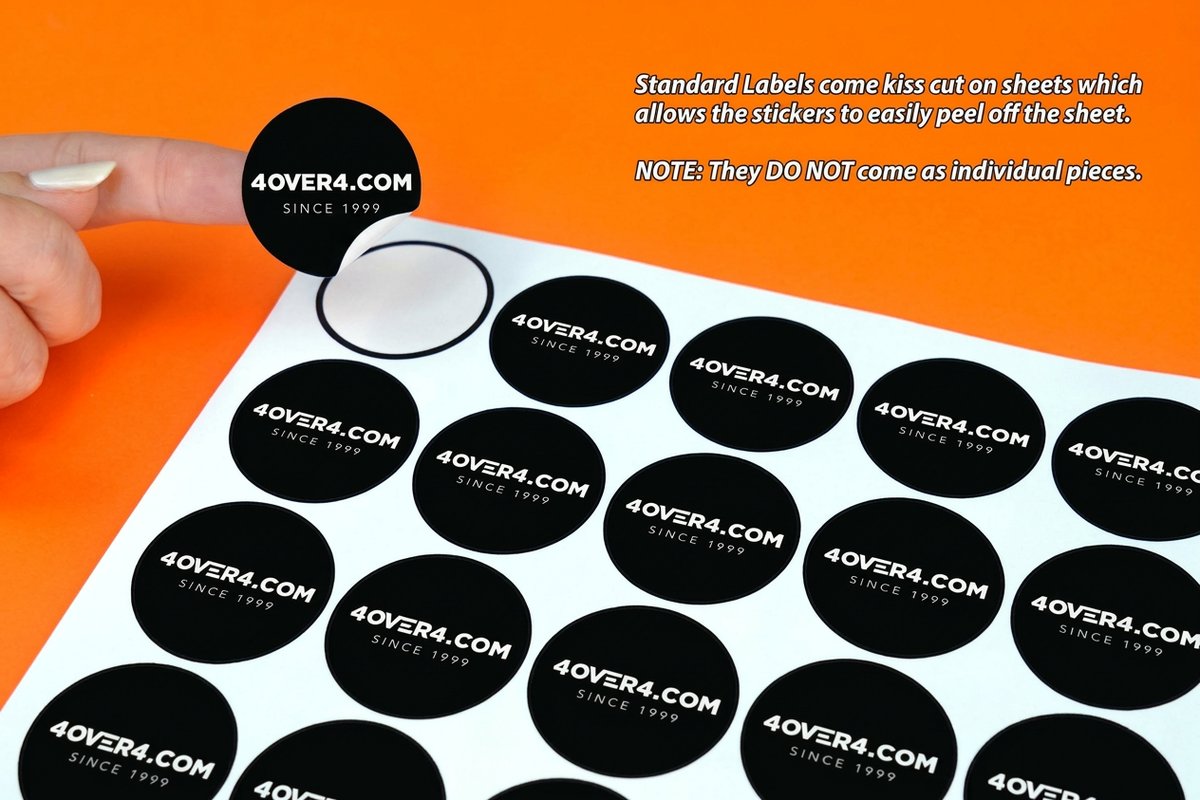
Once you have your size and shape, the print decisions come down to material and finish. Here are the live specs and price-per-unit for standard stickers at 4OVER4.COM, straight from the configurator.
| Quantity | Price Per Unit | Total |
|---|---|---|
| 25 | 95.5¢ | $23.88 |
| 50 | 72.9¢ | $36.44 |
| 100 | 42.7¢ | $42.72 |
| 150 | 32.7¢ | $49.01 |
| 200 | 27.6¢ | $55.29 |
| 250 | 24.6¢ | $61.57 |
| 300 | 22.0¢ | $65.97 |
| 400 | 17.6¢ | $70.36 |
Print it
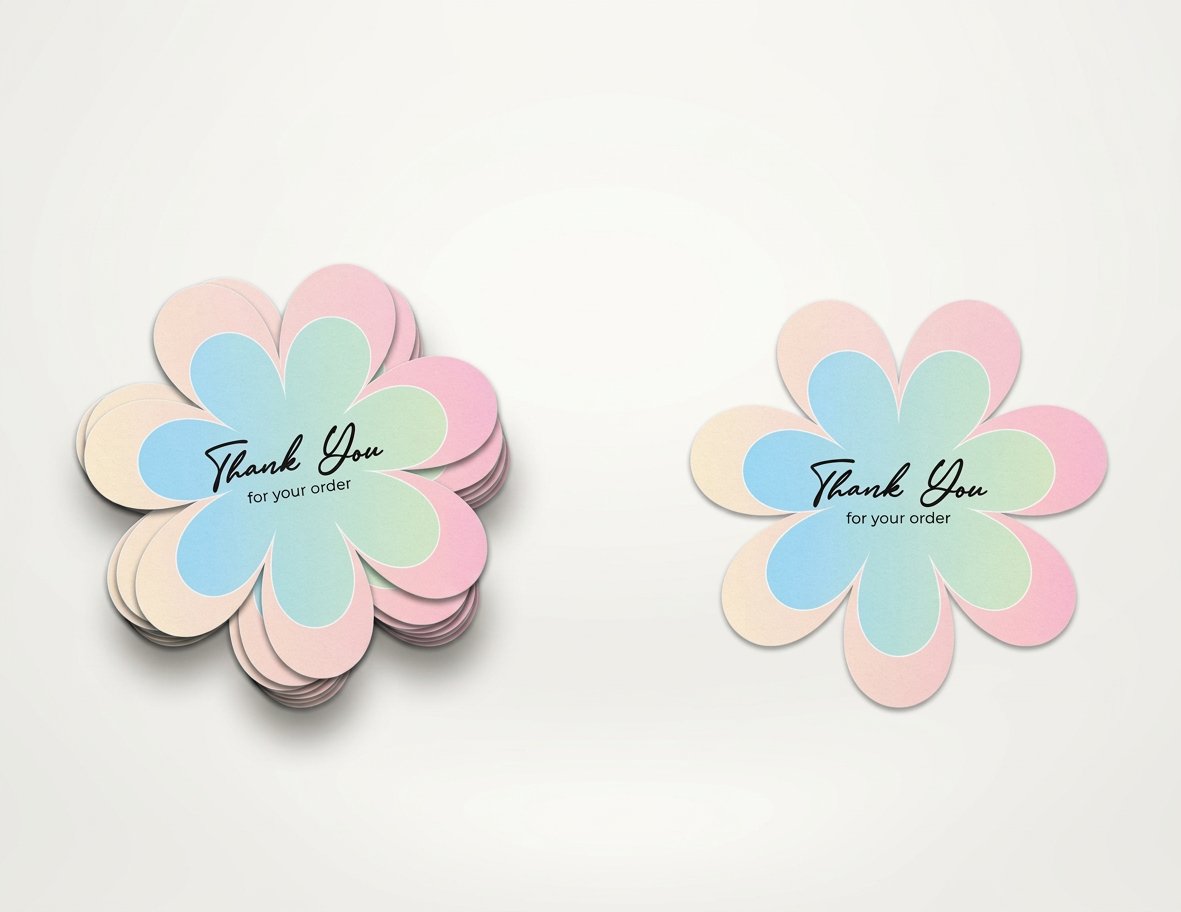
Print stickers and labels at 4OVER4
See it in use
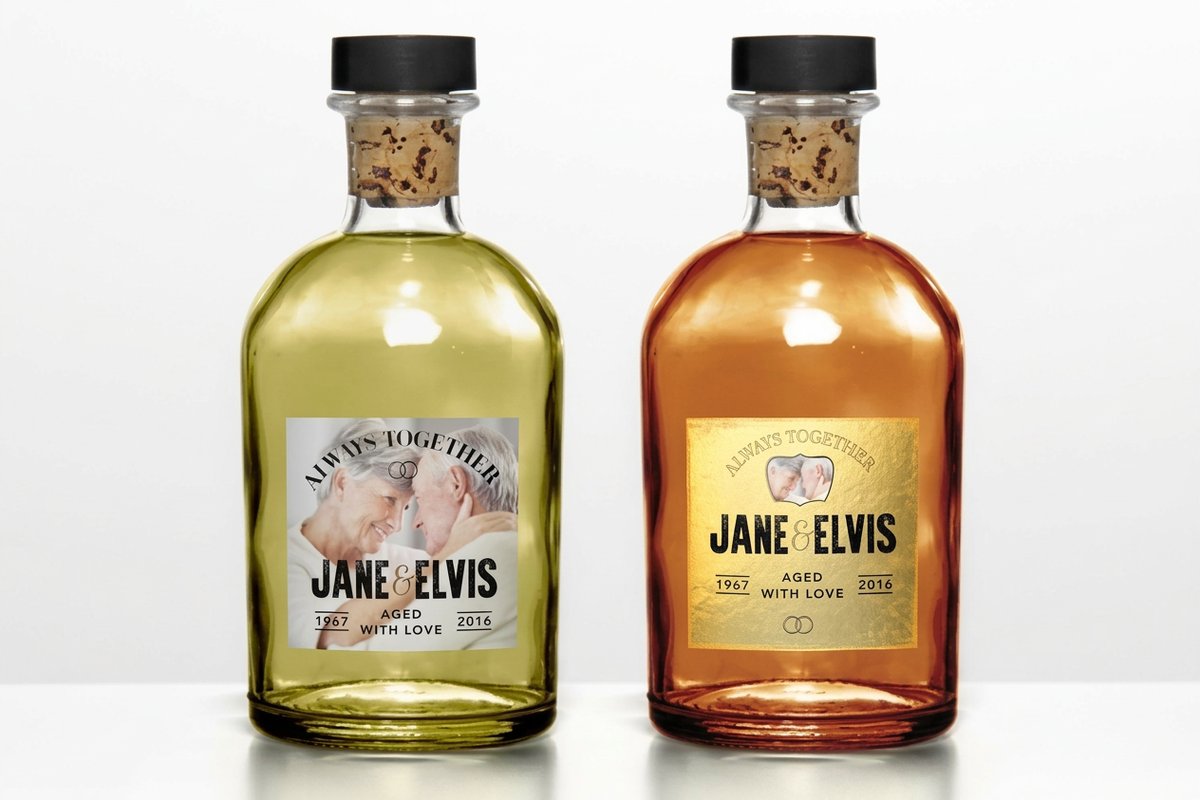
Real stickers and labels, printed in-house
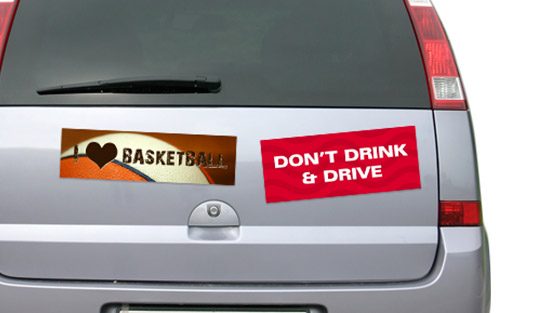

Explore more
Where to go next

By the numbers
Sticker and label printing you can count on at 4OVER4
Common Questions
Common questions about sticker and label sizes
What are the most common sticker sizes?
The most ordered sticker sizes are 2 by 2, 3 by 3, and 4 by 4 inch squares, 3 by 2 and 4 by 6 inch rectangles, and 2 and 3 inch circles. Squares and rectangles are the everyday workhorses for laptops, packaging, and promotions because they are easy to lay out and read. Circles work as seals and badges. The right one depends on where the sticker lives and how far away it needs to be read, but if you want a safe default for a general promo sticker, a 3 by 3 inch square is a reliable starting point.
What is a standard product label size?
There is no single standard, because product labels are sized to the container they wrap. That said, common ranges are roughly 2 to 4 inches wide for a front label on a jar or bottle, with the height set by the panel. Address-style and shipping labels commonly run 4 by 6 or 4 by 3 inches. The rule is to size the label to the surface, leave room for a barcode and any required information, and account for the curve of a round container. Our guide on choosing the correct label size walks through the measurements.
What is the difference between a sticker and a label?
The terms overlap, but in general a sticker is a decorative or promotional adhesive piece, often die cut and applied by hand to laptops, windows, or packaging, while a label is an informational adhesive piece applied to a product or package, such as a product, address, or shipping label. Stickers lean toward branding and fun; labels lean toward information and function. The sizing principles are the same for both: match the piece to its surface, leave a safe area, and add bleed. Our guide comparing stickers, labels, and decals explains where each fits.
When should I use a die cut instead of a standard size?
Use a die cut when your artwork has its own outline that a square or circle would waste space around, such as a logo, a mascot, or an irregular shape. A die cut follows the exact contour of your design at whatever dimension you set, so it looks custom and uses no filler background. Standard shapes are faster to lay out and often the most economical, so they suit simple designs and high volumes. If the shape of the art is part of the appeal, die cut is the way to show it off.
Should I choose roll labels or sheet labels?
Roll labels come on a continuous roll and suit high-volume application, machine dispensing, and product lines that need consistent, fast labeling. Sheet labels and cut-to-size stickers suit smaller runs, hand application, and mixed designs. The size and shape you want are available either way; the choice is really about how you will apply them and how many you need. For a bottling or packaging line, rolls save time. For a small batch or a one-off promo, sheets are simpler. Our roll versus sheet guide compares the two in detail.
How do I set up bleed and safe area for stickers and labels?
Whatever the shape or size, build your file at the final trim dimension, then extend any artwork that reaches the edge 0.125 inch past the cut line so a slight shift never leaves a white sliver. Keep all text, logos, and barcodes inside a safe margin, about 0.125 inch in from the edge, so the trim cannot clip them. For die cuts, the same rules apply along the custom outline. Work in CMYK, place images at 300 DPI, and export a flattened, press-ready PDF. Every order runs through a free file check before printing.
Get Started
Ready to print stickers and labels at the right size?
Pick your shape and size, choose a material and finish, and watch the price update live. Upload your file and the free file check confirms it is ready before printing.
Legal Disclaimer
Gold Standard guarantees apply to all standard orders placed through 4over4.com. Price match requires verifiable proof of a competitor's published price for an equivalent product with matching specifications and turnaround time. Satisfaction guarantee covers manufacturing defects and print quality issues. Contact support with order number and documentation. On-time delivery rate based on tracked orders 1999 to 2026. Individual results may vary based on shipping carrier performance.
