
Booklet Binding Options Explained, From Saddle Stitch to Wire-O


Saddle stitch, perfect binding, Wire-O, plastic coil, and screw post each own a different band of page count, durability, and budget. This guide shows where each one belongs, what it costs to print, and how paper weight quietly settles the answer before you do.
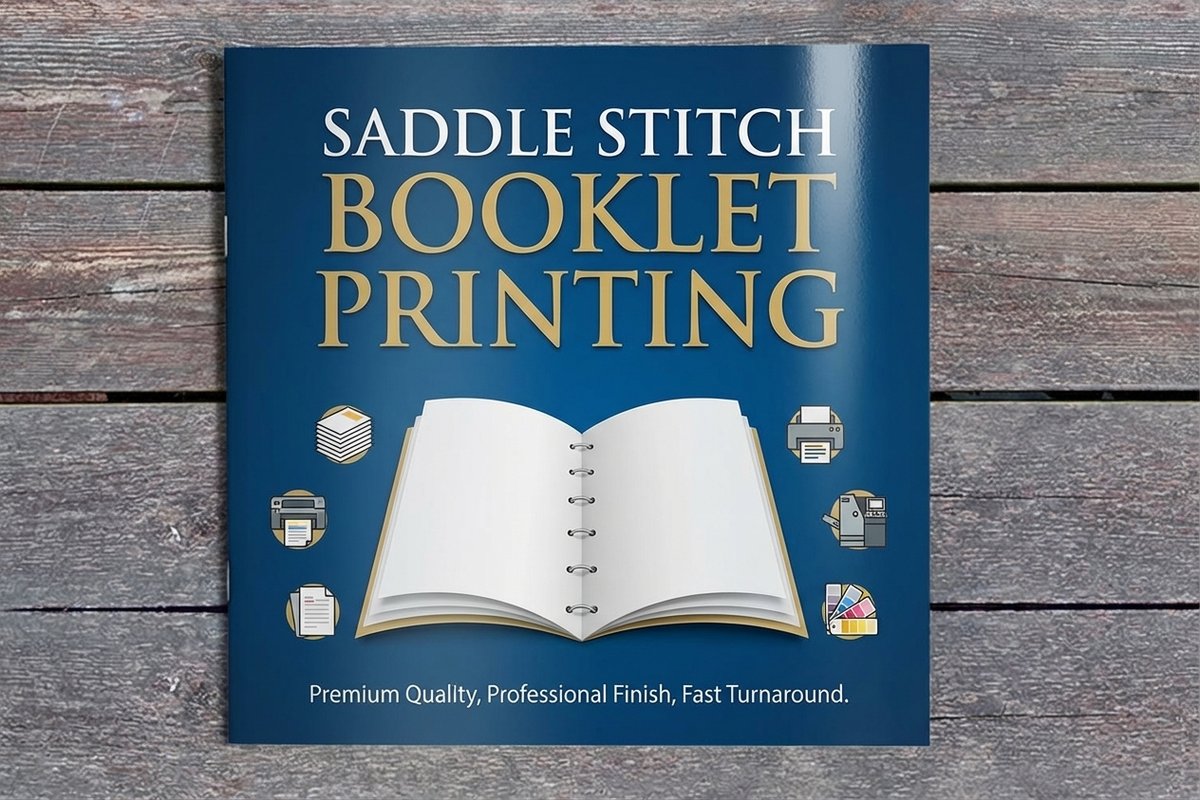
The five booklet binding options are saddle stitch, perfect binding, Wire-O, plastic coil, and screw post. Saddle stitch staples through the spine fold and suits 8 to 64 pages at the lowest cost. Perfect binding glues a square printable spine for 40 pages and up. Wire-O and coil punch and thread the edge so the book lies flat and stays open. Screw posts let pages be swapped later. Page count and paper weight narrow the list first, then budget breaks the tie.
Start here
Every booklet binding option in one paragraph
Booklet binding is the method that holds printed pages together along one edge and controls how the finished piece opens. Saddle stitch drives wire staples through the folded spine and is the fastest, cheapest bind for 8 to 64 pages. Perfect binding glues a square spine you can print on and carries 40 pages to well past 400. Wire-O and plastic coil thread a punched edge so pages turn a full 360 degrees and the booklet lies flat. Screw post binding uses removable posts for content that changes.
Why binding decides how your booklet reads, opens, and survives
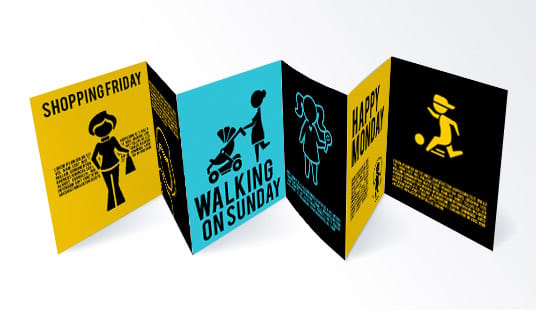
A booklet is the one printed piece that has to work as an object before it works as a message. It gets carried in a bag, opened on a counter, propped against a laptop, and handed back and forth across a table. The bind is what decides whether it survives all of that or comes apart on the second reading.
Most people pick the bind last, after the design is locked and the page count is final, and that is where jobs go wrong. Page count, paper weight, and finished size all constrain which methods are physically possible, so choosing the bind late means either reflowing the layout or accepting a compromise. Deciding early costs nothing. Our saddle stitch booklets and the wider set of binding options are all priced live, so you can test a bind against your real page count before the file is finished. If you also need to settle stock and coating, the companion guide to booklet paper, finish and binding covers that half of the decision in detail.
What are the booklet binding options?
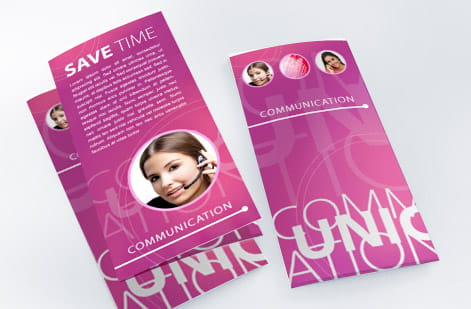
Booklet binding is the method that holds a set of printed pages together along one edge and controls how they open. Commercial printing has settled on a short list, because each method occupies a clear band of page count, durability, and cost. Learn that list once and you never have to guess again.
The five you will actually choose between are saddle stitch, perfect binding, Wire-O, plastic coil, and screw post. Case binding, the true hardcover method, exists above them for keepsake work such as yearbooks and photo books, but it carries a lead time and a cost that most marketing print cannot justify. Everything else you might read about, from Japanese stab binding to loop stitching, is a variation on the same mechanics.
Think of the list as a ladder. Each rung adds durability and page capacity, and adds cost in the same step. The goal is not the strongest bind available, it is the least expensive bind that still holds up through the way your reader actually uses the booklet. Design that makes people keep a booklet in the first place matters just as much as the bind, and seven booklet design ideas for effective marketing is a good place to start on that side.
Saddle stitch, the default for booklets under 64 pages
Saddle stitching takes its name from the saddle shaped support the folded sheets straddle while the stitcher drives wire staples through the spine. Sheets are nested one inside another, so every sheet contributes four pages, and the total page count is always a multiple of four. That single rule catches out more layouts than any other constraint in booklet printing.
The advantages are speed, cost, and how flat the booklet opens. There is no glue to cure and no holes to punch, so saddle stitched work moves through finishing faster than any other bind and costs the least per copy. Spreads that cross the center of the book line up almost perfectly, which is why photo led catalogs and event programs lean on it so heavily.
The limit is bulk. As the page count climbs, the nested sheets push each other outward, an effect called creep, and the inner pages end up trimmed narrower than the outer ones. Good prepress compensates by shifting the layout inward page by page, but past roughly 64 pages on standard text stock the staples cannot hold the fold cleanly and the spine refuses to stay shut. When you hit that wall, move up the ladder instead of fighting it.
Perfect binding, a square printable spine for thicker books

Perfect binding stacks the pages flat, mills a rough texture into the binding edge so adhesive can grip, applies hot melt or PUR glue, and wraps a scored cover around the block. The result is the square spine you see on paperbacks, annual reports, and thick product catalogs.
That spine is the reason to choose it. A booklet that will sit upright on a shelf, in a rack, or in a client filing drawer needs a printed title on the edge, and only perfect binding and case binding give you that surface. It also handles page counts a stapler never could, from about 40 pages up to well past 400, in single page increments rather than multiples of four.
The trade off is how it opens. A perfect bound booklet does not lie flat, so gutter margins have to be generous or your inside copy disappears into the fold. PUR adhesive costs more than standard hot melt but flexes far better in cold weather and on coated stock, which matters if your booklet ships in winter or gets opened hard. Photo spreads that must run edge to edge across the gutter are the one job perfect binding handles worse than saddle stitch.
Wire-O and plastic coil, the binds that lie completely flat

Wire-O and plastic coil are both mechanical binds. Holes are punched along the binding edge, then either a twin loop wire is threaded through and crimped closed, or a continuous plastic spiral is spun through the holes and crimped at each end. Both let pages turn a full 360 degrees, so the booklet folds back on itself and stays open on its own.
That single behavior is why these binds own the training manual, the wall calendar, the recipe collection, and the field reference. Anyone using the booklet while their hands are busy needs it to hold its own page. Wire-O looks more finished and is the choice for anything client facing. Plastic coil is cheaper, comes in colors, and springs back into shape after being crushed in a bag, so it wins for school and workshop material.
Mechanical binding also buys freedom the glued methods do not offer. You can mix paper weights inside one book, add tabbed dividers, insert a clear protective cover, and use almost any page count with no multiple of four rule. The costs are a visible wire or coil instead of a printable spine, a per unit price above saddle stitch, and a punched edge that eats a strip of your design, so keep live copy well clear of the binding edge.
Page count, paper weight, and the specs that rule the decision
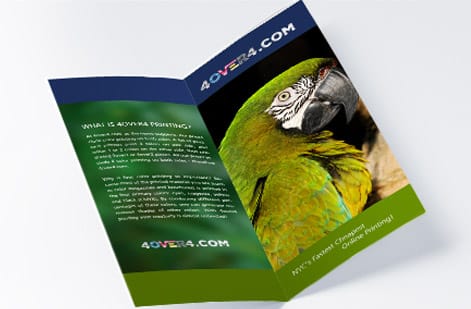
Every binding conversation resolves into two numbers: how many pages, and how thick each one is. Together they produce the spine bulk, and spine bulk is what makes a method work or fail. A 48 page booklet on 70 lb text is a comfortable saddle stitch. The same 48 pages on 100 lb gloss text is a fat, stubborn spine that will not stay closed.
Use the count first. Eight to 64 pages sits in saddle stitch territory. Forty to 400 plus pages belongs to perfect binding, with the two methods overlapping in the forties and fifties where either choice is defensible. Mechanical binding covers roughly 20 to 300 pages and gets chosen for how it opens rather than for capacity. Screw post binding is the outlier, picked when pages need swapping later rather than for any page count reason.
Then check the stock. Heavier text weight helps perfect binding, because milled edges give adhesive more to hold, and hurts saddle stitch, because bulk fights the fold. Cover weight matters too, since an 80 lb cover on a saddle stitched booklet needs scoring before folding or it will crack along the spine. Coated stock needs PUR glue rather than standard hot melt when perfect bound, because adhesive struggles to key into a sealed surface.
How to choose your bind and what it costs to print
Run the decision in this order and it takes about a minute. First, lock the final page count and round it to a multiple of four if you want saddle stitch on the table. Second, ask whether the booklet will be shelved, because a shelved booklet needs a printable spine and that means perfect binding. Third, ask whether the reader has to work from the open page, because that answer forces Wire-O or coil. Fourth, ask whether pages will be replaced later, which is the only real case for screw posts. Whatever survives all four questions is your bind.
Pricing follows the same inputs. Page count, text and cover stock, finished size, and quantity set the number, and binding labor is already inside the per booklet price rather than billed separately. Saddle stitch booklet printing starts at $240.55 for a complete run, and the price per copy drops steeply as quantity climbs, because setup is spread across more books. Mechanical binds carry a higher unit cost, since every book is punched and threaded individually rather than passing through a stitcher in one motion. Compare every bound format side by side in the binding options collection, then configure your exact spec and see live pricing before you commit.
Wally explains booklet binding
Pick the bind for how the booklet gets used, not for how it looks in a mockup
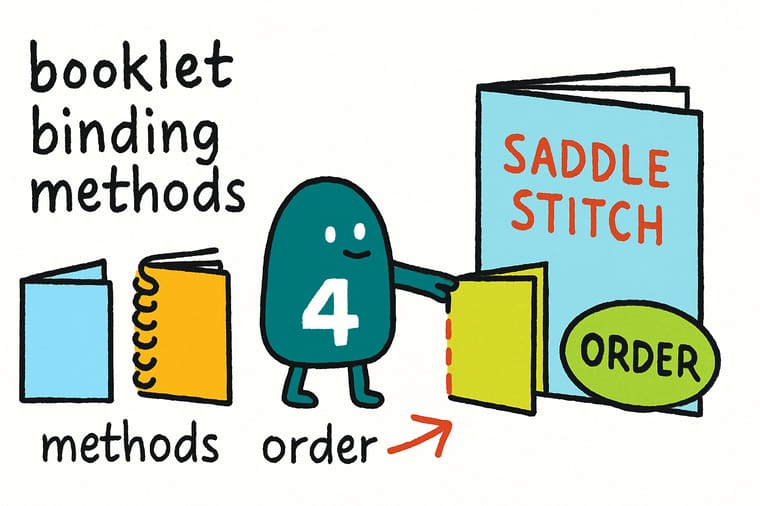
Wally asks one question before anything else: what is the reader doing while the booklet is open? Flipping through it on a train means staples are plenty. Living on a shelf between competitors means it needs a printed spine. Following step four with a tool in one hand means it has to lie flat on its own. Answer that, confirm the paper weight, and the right bind has already chosen itself.
Configure a bound booklet →Infographic
Booklet binding options at a glance
One frame, seven binding methods, each with the page range it handles and the job it was built for. Save it, print it, or keep it open beside your layout while you finalize the page count.
Page ranges are practical working limits on standard text stock, not hard machine limits. Heavier paper shortens the saddle stitch range and strengthens the case for a glued or mechanical bind.
Specs and pricing
Saddle stitch booklet specs and live pricing
Once the page count and the bind are settled, the rest is spec work. Here are the sizes, stocks, and page counts we run on saddle stitch booklets, with pricing that updates as you change the configuration.
| Quantity | Price Per Unit | Total |
|---|---|---|
| 25 | $9.62 | $240.55 |
| 50 | $6.04 | $302.06 |
| 100 | $3.61 | $361.37 |
| 200 | $2.22 | $444.85 |
| 300 | $1.65 | $495.38 |
| 400 | $1.29 | $515.14 |
| 500 | $1.06 | $531.61 |
| 600 | 91.5¢ | $549.19 |
Print it
Bind and print your next booklet at 4OVER4
See it in use
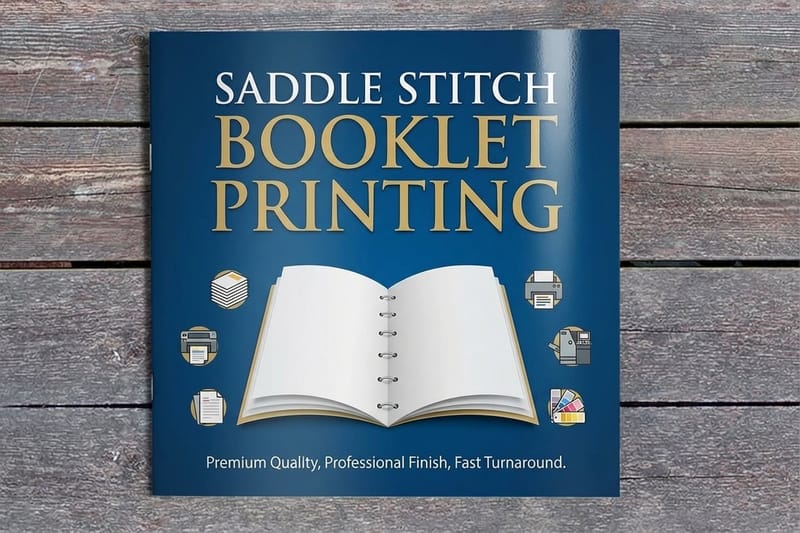
Real bound booklets, printed in-house
Explore more
Where to go next
By the numbers
Booklet printing you can count on at 4OVER4.COM
Common Questions
Common questions about booklet binding options
What is saddle-stitched binding?
Saddle stitching nests printed sheets inside one another, folds them together, and drives two or three wire staples through the spine fold. The finished booklet opens close to flat and always lands on a page count divisible by four, because every sheet carries four pages. It is the fastest and least expensive bind in commercial printing, which is why catalogs, event programs, newsletters, and short manuals of 8 to 64 pages almost always use it.
What is wire-o binding?
Wire-O punches a row of rectangular holes along the binding edge and threads a twin loop wire through them, then closes the wire into a cylinder. Pages rotate a full 360 degrees and the booklet lies dead flat on a desk without being held open. That makes it the standard for training manuals, wall calendars, and reference guides. Wire-O handles a wide page range, mixes paper weights freely, and accepts tab dividers or a clear cover without changing the bind.
What are the booklet binding options?
Five methods cover almost every commercial job. Saddle stitch staples through the fold, perfect binding glues a square printable spine, Wire-O and plastic coil use punched holes with a metal or plastic spine, and screw post binding uses removable posts through drilled holes. Case binding, the hardcover method, sits above all of them in cost and lead time and suits keepsake work such as yearbooks rather than everyday marketing print.
How do I choose the right booklet binding option?
Start with page count, then how the booklet gets used, then budget. Under 64 pages on normal text stock points to saddle stitch. Over 64 pages, or any job that needs a printed spine, points to perfect binding. Anything read hands free while someone works points to Wire-O or coil. Content that gets swapped out points to screw posts. Budget only breaks ties, because the wrong bind on a heavy booklet fails no matter how little it cost.
What does booklet binding cost and how is the price set?
Binding is priced inside the booklet rather than as a separate line, and four inputs move the number: total page count, paper weight for text and cover, finished size, and quantity. Saddle stitch booklet printing starts at $240.55 for a full run at 4OVER4.COM. Mechanical binds cost more per unit because each book is punched and threaded individually, and hardcover case binding costs the most. Per book pricing falls sharply as quantity rises, since setup is spread across the run.
How many pages can a saddle stitched booklet hold?
The practical ceiling is 64 pages on standard 80 lb text, and fewer on heavier stock. Past that limit the nested sheets push the inner pages outward, the trimmed edge goes ragged, and the staples struggle to hold the fold closed. If your content lands between 64 and 80 pages, either cut a signature, drop to a lighter text stock, or move the job to perfect binding instead of forcing the staples to do work they cannot do.
What sizes, stocks, and finishes are available for booklets?
The common finished sizes are 8.5 x 11, 5.5 x 8.5, 6 x 9, and square formats such as 8 x 8. Text pages run on 70 lb to 100 lb text weight, and covers usually run on 80 lb to 100 lb cover, coated or uncoated. Gloss, matte, and soft touch laminates are all available on the cover, and matte is the safer pick when readers will write on the booklet. Every combination is priced live on the product page before you order.
Get Started
Ready to get your booklet bound and printed?
Upload your file, pick the page count and the bind that fits how the booklet will be used, and see live pricing before you order. Every bound job is printed and finished in house.
Legal Disclaimer
Gold Standard guarantees apply to all standard orders placed through 4over4.com. Price match requires verifiable proof of a competitor's published price for an equivalent product with matching specifications and turnaround time. Satisfaction guarantee covers manufacturing defects and print quality issues. Contact support with order number and documentation. On-time delivery rate based on tracked orders 1999 to 2026. Individual results may vary based on shipping carrier performance.
